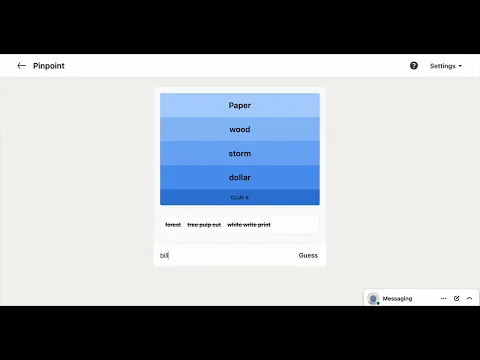
LinkedIn Pinpoint #459 Answer & Analysis
Looking for the Pinpoint #459 answer? Beyond Paper, Wood, Storm, Dollar, and Castle, the logic is trickier than you think. It's not about things affected by the elements! Get our fast answer and expert logic tips below to save your streak now.
LinkedIn Pinpoint 459 Clues & Answer
💡 Hover (desktop) or tap (mobile) each clue to see how it connects to the answer
#1
Forms "Sandpaper," an abrasive material used for smoothing surfaces.
#2
Refers to "Sandalwood" (a fragrant wood) or "Sand wood" (the act of finishing wood).
#3
Forms "Sandstorm," a meteorological phenomenon in arid regions.
#4
Forms "Sand dollar," a flat, burrowing sea urchin (Clypeasteroida).
#5
Forms "Sandcastle." The qualifier "if not on stands" ensures the player thinks of the beach structure.
Answer: Words that come after 'sand'
LinkedIn Pinpoint #459 Expert Logic
1. Introduction
LinkedIn Pinpoint #459 is a masterclass in linguistic compounding. At first glance, the clues span across abrasive tools, meteorology, marine biology, and architecture. However, the unifying thread isn't a physical location or a shared utility, but rather a single four-letter prefix: Sand. This puzzle challenges the player to identify how a common substance acts as a "chameleon" word, fundamentally changing the meaning of the nouns it precedes.
2. How the Puzzle Came Together
The puzzle construction utilizes a "divergent-to-convergent" logic. It starts with Paper and Wood, which might lead a player to think of "Construction" or "Carpentry." However, the introduction of Storm immediately shifts the scale from a workshop to the natural elements. This is a classic Pinpoint pivot designed to break a narrow mental set.
The logic solidifies with the inclusion of Dollar. While "Dollar" usually evokes currency, the juxtaposition with nature-themed clues pushes the player toward the biological "Sand dollar." Finally, Castle (if not on stands) serves as the definitive anchor. By specifying "if not on stands," the puzzle creator eliminates chess pieces or toy playsets, pointing directly to the ephemeral structures built on a beach. This progression demonstrates a high level of "semantic range," requiring the player to jump between disparate fields—industry, weather, finance, and leisure—to find the common linguistic denominator.
3. Category: Pinpoint 459
- A. Core Answer: Words that come after 'sand'
- B. Difficulty Rating: 3.4 / 5.0 (The transition from "Paper" to "Dollar" requires a significant lateral leap).
4. Words & How They Fit
Semantic Logic Breakdown
- Prefix Transformation: The word "Sand" modifies each clue to create a new, specific entity that is often unrelated to the original clue's primary definition (e.g., a "Sand dollar" is not currency).
- Physical Association: Most resulting words relate to the texture, composition, or environment of sand.
Logic Role Classification
| Clue | Logical Role | Why it fits |
|---|---|---|
| Paper | The Industrial Lead | Forms "Sandpaper," an abrasive material used for smoothing surfaces. |
| Wood | The Material Link | Refers to "Sandalwood" (a fragrant wood) or "Sand wood" (the act of finishing wood). |
| Storm | The Environmental Shift | Forms "Sandstorm," a meteorological phenomenon in arid regions. |
| Dollar | The Biological Pivot | Forms "Sand dollar," a flat, burrowing sea urchin (Clypeasteroida). |
| Castle | The Logical Anchor | Forms "Sandcastle." The qualifier "if not on stands" ensures the player thinks of the beach structure. |
5. Better Analysis Directions
A. Semantic Trap深度拆解 (The "Beach" Trap)
Many players see Storm, Dollar, and Castle and immediately guess "Things found at the beach." However, Paper (Sandpaper) is rarely a beach item, and Wood (in the context of Sandalwood) is a forest product. The "Expert" realizes that the connection isn't situational (where they are) but lexical (how the words are built).
B. Historical Pattern (The Prefix Pivot)
Pinpoint frequently uses "The Blank Filler" logic (Mode-1). Historically, when clues are generic nouns like "Paper" or "Storm," the answer is almost always a shared prefix or suffix. #459 follows the "Prefix-Noun" pattern, which is a common trope in competitive word puzzles like the NYT Connections.
C. The Expert Workflow
- Initial Scan: Look at Paper and Wood. Potential links: "Table," "Pulp," "Furniture."
- Constraint Testing: Does Storm fit "Furniture"? No. Does Storm fit "Paper"? Yes, via "Sand."
- Verification: Test "Sand" against the remaining clues. Sand dollar (Check), Sandcastle (Check).
- Final Refinement: Ensure the answer describes the position of the word "Sand" relative to the clues.
6. Lessons Learned From Pinpoint 459
The primary takeaway from #459 is to distinguish between "Thematic Association" and "Linguistic Construction." While three clues share a beach theme, the other two do not. In high-level Pinpoint puzzles, if 60% of clues fit a theme but 40% don't, you must abandon the theme and look for a structural or phonetic link.
💡 Trivia: The Living Currency of the Sea
The Sand dollar (the "Dollar" clue) isn't just a pretty shell found on the shore; it is the skeleton (called a "test") of a living sea urchin! When they are alive, they are covered in tiny, velvet-like spines and are usually purple or reddish-brown.
They earned the name "dollar" because their bleached white skeletons reminded early beachcombers of large silver coins. In some folklore, they were even considered the lost currency of mermaids or the people of Atlantis!
FAQ
Q: Why was the "if not on stands" qualifier added to Castle? A: This is a precision tool. A "Castle" could be a chess piece (which sits on a board/stand) or a plastic toy. By excluding "stands," the puzzle forces you to think of a structure that sits directly on the ground—specifically, a sandcastle on a beach.
Q: Does "Sand" always come before "Wood"? A: In the context of "Sandalwood," yes. While "Sand wood" can be a verb phrase (to sand wood), Pinpoint usually looks for the creation of a compound word or a very common specific noun.
Watch the logic walkthrough