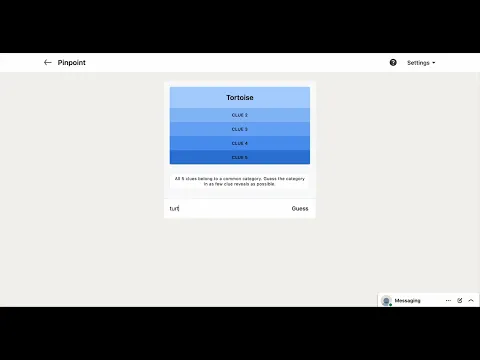
LinkedIn Pinpoint #490 Answer & Analysis
Looking for the Pinpoint #490 answer? Beyond Tortoise, Molasses (treacle), Sloth, Snail, and Traffic jams, the logic is trickier than you think. It's not about just animals! Get our fast answer and expert logic tips below to save your streak now.
LinkedIn Pinpoint 490 Clues & Answer
💡 Hover (desktop) or tap (mobile) each clue to see how it connects to the answer
#1
Famous for winning the race through persistence rather than speed.
#2
Used in the common idiom "slow as molasses in January" to describe high viscosity.
#3
An animal named after one of the seven deadly sins, characterized by extreme laziness/slowness.
#4
Represents "snail's pace," the standard unit of measurement for frustratingly slow movement.
#5
The urban manifestation of "slow," representing a halt in expected logistical flow.
Answer: Slow things
LinkedIn Pinpoint #490 Expert Logic
1. Introduction
LinkedIn Pinpoint #490 is a classic study in thematic consistency across disparate domains. While the clues span biology, culinary chemistry, and urban logistics, they are unified by a single physical property: a lack of velocity. This puzzle challenges the player to move past the specific biological or chemical nature of the items and identify the universal adjective that describes their movement—or lack thereof.
2. How the Puzzle Came Together
The puzzle construction relies on high-recognition archetypes of lethargy. It starts with the Tortoise, the quintessential symbol of "slow and steady" from Aesop’s Fables. To prevent the player from guessing "Reptiles" or "Animals," the logic shifts to the kitchen with Molasses (treacle). This introduces the concept of viscosity—a liquid that resists flow.
The biological theme returns with the Sloth and the Snail, two creatures whose very names are synonymous with a low-speed lifestyle. These serve to reinforce the "velocity" theme. Finally, the inclusion of Traffic jams (even with the unusual qualifier "if not on stands"—likely a conceptual nod to stationary movement) anchors the puzzle in the modern human experience. Whether organic, chemical, or systemic, every clue in this set is a victim of friction, physics, or biology that prevents rapid transit.
3. Category: Pinpoint 490
- A. Core Answer: Slow things
- B. Difficulty Rating: 1.5 / 5.0 (The clues are highly idiomatic, making the connection relatively intuitive for most players.)
4. Words & How They Fit
Semantic Logic Breakdown
- Biological Pacing: Three clues represent the animal kingdom's slowest movers.
- Viscosity & Friction: One clue represents a physical substance, and one represents a systemic failure of movement.
Logic Role Classification
| Clue | Logical Role | Why it fits |
|---|---|---|
| Tortoise | Cultural Archetype | Famous for winning the race through persistence rather than speed. |
| Molasses (treacle) | Material Metaphor | Used in the common idiom "slow as molasses in January" to describe high viscosity. |
| Sloth | Etymological Link | An animal named after one of the seven deadly sins, characterized by extreme laziness/slowness. |
| Snail | Idiomatic Anchor | Represents "snail's pace," the standard unit of measurement for frustratingly slow movement. |
| Traffic jams | Modern systemic | The urban manifestation of "slow," representing a halt in expected logistical flow. |
5. Better Analysis Directions
A. Red Herring Analysis (The "Nature" Trap)
A novice player might see Tortoise, Sloth, and Snail and immediately gravitate toward "Animals" or "Shelled Creatures." However, the "Expert" looks for the outlier. Molasses and Traffic jams are not biological entities. Therefore, the connection must be a property they share with the animals, not a taxonomic classification.
B. Historical Pattern (The Property Link)
Pinpoint frequently uses "Property Links" where every item is an example of an adjective (e.g., Things that are blue, Things that are sharp). In #490, "Slow" acts as the unifying adjective. Historically, these are the most common types of Pinpoint puzzles, designed to reward players who can think abstractly rather than just categorically.
C. The Expert Workflow
- Identify the outliers: Immediately note that Molasses and Traffic jams break the "Animal" theme.
- Extract the shared trait: What does a snail have in common with a traffic jam? Low speed.
- Cross-check the remaining clues: Does a Sloth move slowly? Yes. Is a Tortoise slow? Yes.
- Finalize the Answer: Ensure the answer is a plural noun phrase ("Slow things") to match the collective nature of the clues.
6. Lessons Learned From Pinpoint 490
This puzzle teaches us the importance of cross-domain verification. If you find a pattern that only fits 3 out of 5 clues (like "Animals"), it is a distractor. A true Pinpoint solution must be a "Golden Thread" that passes through every single clue without exception. When you see a mix of living things and inanimate objects, look for a shared physical or descriptive property.
💡 Trivia: The Deadly Side of "Slow as Molasses"
The phrase "slow as molasses" usually implies a harmless delay, but history tells a different story. In 1919, the "Great Molasses Flood" occurred in Boston when a giant storage tank burst.
Despite its reputation for being slow, a 25-foot-high wave of molasses rushed through the streets at 35 miles per hour (56 km/h). Because of its high density and viscosity, it was nearly impossible to escape, proving that even the "slowest" things can become incredibly dangerous under the right physical conditions!
FAQ
Q: Why is "treacle" mentioned in parentheses? A: "Treacle" is the British English equivalent of "Molasses." Pinpoint includes it to ensure the puzzle is accessible to English speakers globally, maintaining its "Universal Design" standard.
Q: Could "Animals" have been a secondary answer? A: No. In Pinpoint, every clue must fit. Since "Traffic jams" and "Molasses" are not animals, that category is logically invalidated.
Q: What is the significance of "if not on stands" for Traffic Jams? A: This appears to be a carry-over or a specific qualifier meant to distinguish a "moving" traffic jam from a "parked" situation, though in most Pinpoint iterations, "Traffic jams" stands alone as a sufficient clue for "slowness."
Watch the logic walkthrough