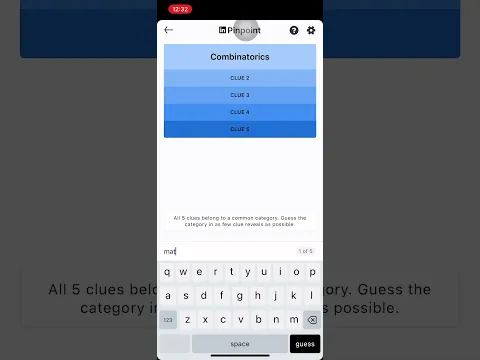
LinkedIn Pinpoint #508 Answer & Analysis
Looking for the Pinpoint #508 answer? Beyond Combinatorics, Topology, Calculus, Statistics, and Geometry, the logic is trickier than you think. It's not about just theoretical frameworks! Get our fast answer and expert logic tips below to save your streak now.
LinkedIn Pinpoint 508 Clues & Answer
💡 Hover (desktop) or tap (mobile) each clue to see how it connects to the answer
#1
A specialized branch dealing with combinations; sets the high-level academic tone.
#2
Focuses on properties preserved through deformation; bridges the gap between shape and logic.
#3
The most universally recognized advanced math subject; acts as a primary identifier.
#4
Represents the data-driven side of mathematics, ensuring the category isn't limited to "pure" math.
#5
The parenthetical "if not on stands" distinguishes the *subject* from the *physical model*.
Answer: Subjects in mathematics
LinkedIn Pinpoint #508 Expert Logic
1. Introduction
LinkedIn Pinpoint #508 is a masterclass in academic classification. This puzzle challenges players to look past the complex, often intimidating terminology of high-level science to find a common structural thread. While these terms represent vastly different methods of understanding the universe—from the discrete counting of objects to the continuous flow of change—they all reside under the singular umbrella of formal mathematical science.
2. How the Puzzle Came Together
The puzzle construction utilizes a "difficulty gradient" to test the player’s breadth of knowledge. It starts with Combinatorics, a term that might feel esoteric to those outside of computer science or advanced math, immediately signaling a "Specialty Set." This is quickly followed by Topology, which shifts the focus toward the properties of space and shape, reinforcing the academic nature of the list.
To provide a bridge for the general player, the logic introduces Calculus and Statistics. These are the "recognizable anchors"—subjects most people encounter in secondary or higher education. The final clue, Geometry (if not on stands), is the puzzle's signature witty inclusion. By adding the parenthetical "if not on stands," the game creator playfully acknowledges that while Geometry is a theoretical branch of math, physical geometric models (like globes or polyhedral frames) are often displayed as physical objects. This clever qualifier forces the player to strip away the physical context and return to the abstract: the academic subject itself.
3. Category: Pinpoint 508
- A. Core Answer: Subjects in mathematics
- B. Difficulty Rating: 3.8 / 5.0 (The technical nature of "Combinatorics" and "Topology" elevates the difficulty for non-STEM players).
4. Words & How They Fit
Semantic Logic Breakdown
- Academic Taxonomy: Each word represents a recognized "Major" or "Field of Study" within the mathematical sciences.
- Abstract Frameworks: Unlike physical sciences (Biology, Chemistry), these clues represent systems of logic and calculation that do not require physical matter to exist.
Logic Role Classification
| Clue | Logical Role | Why it fits |
|---|---|---|
| Combinatorics | The Niche Barrier | A specialized branch dealing with combinations; sets the high-level academic tone. |
| Topology | The Spatial Abstract | Focuses on properties preserved through deformation; bridges the gap between shape and logic. |
| Calculus | The Foundational Pillar | The most universally recognized advanced math subject; acts as a primary identifier. |
| Statistics | The Applied Branch | Represents the data-driven side of mathematics, ensuring the category isn't limited to "pure" math. |
| Geometry | The Semantic Pivot | The parenthetical "if not on stands" distinguishes the subject from the physical model. |
5. Better Analysis Directions
A. Red Herring Analysis (The "Science" Trap)
A common pitfall in #508 is selecting a category that is too broad, such as "Science Subjects." While math is the language of science, an expert player notes the absence of Physics or Chemistry. The clues are strictly confined to the deductive reasoning of mathematics. The "Geometry" qualifier is the strongest hint here—it prevents the player from thinking of "Museum Exhibits" or "Artistic Shapes."
B. Historical Pattern (Academic Clusters)
Pinpoint frequently groups items by their University Department. We have seen similar puzzles involving "Social Sciences" or "Parts of a Lab." The inclusion of "Geometry" with a qualifier is a classic Pinpoint move to prevent ambiguity, a pattern seen in earlier puzzles where a word could be both a noun and a verb.
C. The Expert Workflow
- Initial Scan: Recognize Calculus and Statistics as high-school/college math staples.
- Pattern Match: Identify Combinatorics and Topology as advanced extensions of the same field.
- Logical Refinement: Interpret the "Geometry" joke. If it's "not on a stand," it's an abstract concept.
- Final Synthesis: Define the set not just as "Math," but specifically as "Subjects" or "Branches" of the discipline.
6. Lessons Learned From Pinpoint 508
Precision is the key to high-level Pinpoint puzzles. When you see technical terms like Combinatorics, don't be intimidated by the complexity of the subject itself. Instead, look at its classification. This puzzle teaches us that the "flavor text" (the words in parentheses) is often the most important clue for narrowing down a broad category to a specific one.
💡 Trivia: The "Rubber Sheet" Geometry
While Topology is a core subject in mathematics, it is famously nicknamed "Rubber Sheet Geometry." This is because topologists treat objects as if they are made of infinitely stretchable rubber.
In the eyes of a topologist, a coffee mug and a doughnut are exactly the same thing (homeomorphic) because they both have exactly one hole. You could theoretically deform the mug into the shape of a doughnut without tearing the material or gluing parts together. However, you could never turn that doughnut into a Calculus textbook—no matter how much you stretch it!
FAQ
Q: Is Combinatorics actually used in real life? A: Absolutely. It is the backbone of computer science, used in everything from routing your GPS directions to securing your bank transactions via cryptography.
Q: Why was the "if not on stands" added to Geometry? A: It's a linguistic safeguard. A "Geometry" (specifically a geometric model) can be a physical object on a desk. By saying "if not on stands," the puzzle clarifies we are talking about the curriculum or subject, which is intangible.
Q: Could "Algebra" have replaced any of these clues? A: Yes, Algebra would have been an excellent "Foundational Pillar" clue, though perhaps it would have made the puzzle a bit too easy compared to "Combinatorics."
Watch the logic walkthrough