LinkedIn Pinpoint #513 Answer & Analysis
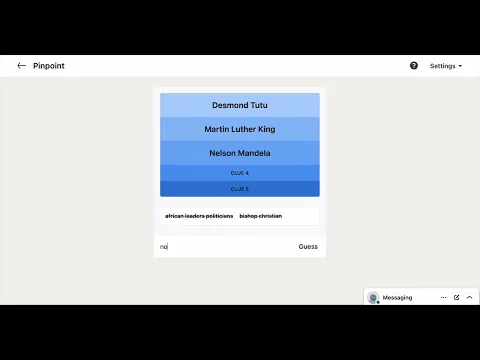
Looking for the Pinpoint #513 answer? Beyond Desmond Tutu, Martin Luther King, Nelson Mandela, Kofi Annan, and Médecins Sans Frontières, the logic is trickier than you think. It's not about just African leaders! Get our fast answer and expert logic tips below to save your streak now.
LinkedIn Pinpoint 513 Clues & Answer
💡 Hover (desktop) or tap (mobile) each clue to see how it connects to the answer
#1
Won in 1984; reinforces the South African theme but adds a moral/religious layer.
#2
Won in 1964; represents the struggle against racial injustice.
#3
Won in 1993; represents the transition from prisoner to president.
#4
Won in 2001; represents the institutional efforts of the United Nations.
#5
Won in 1999; proves the category includes organizations, not just individuals.
Answer: Nobel Peace Prize winners
LinkedIn Pinpoint #513 Expert Logic
1. Introduction
LinkedIn Pinpoint #513 is a masterclass in identifying global humanitarian excellence. This puzzle transcends geography and era, bringing together some of the most influential figures of the 20th and 21st centuries. While their specific battles—ranging from racial segregation in America to apartheid in South Africa and humanitarian crises worldwide—differ, they are united by the highest form of international recognition for peace-building.
2. How the Puzzle Came Together
The puzzle begins with two of the most recognizable names in history: Martin Luther King and Nelson Mandela. For most players, these names immediately trigger thoughts of "Civil Rights" or "Freedom Fighters." However, the logic deepens with the inclusion of Desmond Tutu. While Tutu shares the South African anti-apartheid connection with Mandela, his role as a religious leader shifts the focus toward a broader moral authority.
The complexity increases with Kofi Annan. As a former Secretary-General of the United Nations, Annan moves the category from "activism" to "global diplomacy." The final piece, Médecins Sans Frontières (Doctors Without Borders), acts as the definitive logic gate. By including an international NGO rather than an individual, the puzzle signals that the connection isn't just "famous people," but a specific prestigious honor that can be bestowed upon both individuals and organizations.
3. Category: Pinpoint 513
- A. Core Answer: Nobel Peace Prize winners
- B. Difficulty Rating: 2.8 / 5.0 (While the names are famous, distinguishing the Nobel Peace Prize from general "human rights awards" requires a moment of specific recall.)
4. Words & How They Fit
Semantic Logic Breakdown
- Humanitarian Merit: Every clue represents a recipient of the Nobel Peace Prize awarded by the Norwegian Nobel Committee.
- Diverse Impact: The clues cover civil rights (King), reconciliation (Mandela/Tutu), diplomacy (Annan), and medical humanitarianism (MSF).
Logic Role Classification
| Clue | Logical Role | Why it fits |
|---|---|---|
| Martin Luther King | The Historical Anchor | Won in 1964; represents the struggle against racial injustice. |
| Nelson Mandela | The Symbolic Peak | Won in 1993; represents the transition from prisoner to president. |
| Desmond Tutu | The Regional Link | Won in 1984; reinforces the South African theme but adds a moral/religious layer. |
| Kofi Annan | The Diplomatic Scale | Won in 2001; represents the institutional efforts of the United Nations. |
| Médecins Sans Frontières | The Institutional Pivot | Won in 1999; proves the category includes organizations, not just individuals. |
5. Better Analysis Directions
A. Red Herring Analysis (The "South Africa" Trap)
A common mistake in #513 is focusing too heavily on the "South African Leaders" connection (Mandela and Tutu). However, Martin Luther King (American) and Kofi Annan (Ghanaian) immediately break a purely geographic link. The "Expert" looks for the common denominator that spans continents.
B. Historical Pattern (The Award Category)
Pinpoint often uses "Prestigous Groups" (e.g., EGOT winners, Pulitzer Prize winners). When you see a list of high-profile historical figures, the logic usually points toward a shared award or a specific "First" (e.g., First to walk on the moon). #513 follows the "Shared Award" pattern, which is a staple of LinkedIn's puzzle design.
C. The Expert Workflow
- Identify the Icons: Recognize Mandela and King as the pillars of the set.
- Define the Scope: "Are they all activists?" Yes, but MSF is an organization. "Are they all politicians?" No, Tutu was a bishop.
- Search for the Common Honor: What is the single most famous award all five have won? The Nobel Peace Prize.
- Verification: Confirm the dates (1964, 1984, 1993, 1999, 2001). The timeline is consistent.
6. Lessons Learned From Pinpoint 513
This puzzle teaches us the importance of Category Breadth. When you see a list of names, don't just look at who they are, look at what they received. In Pinpoint, a mix of individuals and organizations (like MSF) is a massive hint that the answer is a prize, an award, or a specific status rather than a profession.
💡 Trivia: The "Other" Nobel Location
While the Nobel Prizes for Physics, Chemistry, Medicine, and Literature are awarded in Stockholm, Sweden, the Nobel Peace Prize is the only one awarded in Oslo, Norway.
Alfred Nobel never explicitly explained why he wanted the Peace Prize to be awarded in Norway (which was in a union with Sweden at the time). Some historians believe it was because Norway did not have the same military traditions as Sweden, making it a more "neutral" ground for a prize dedicated to peace!
FAQ
Q: Why was Médecins Sans Frontières included instead of another person? A: Including an organization like MSF makes the puzzle more robust. It prevents players from guessing "Famous Leaders" and forces them to find the specific commonality—the Nobel Peace Prize—which is one of the few honors that can be awarded to a group.
Q: Did all these people win in the same decade? A: No. The winners in this set span from 1964 (MLK) to 2001 (Kofi Annan), showing the long-standing history of the award.
Watch the logic walkthrough