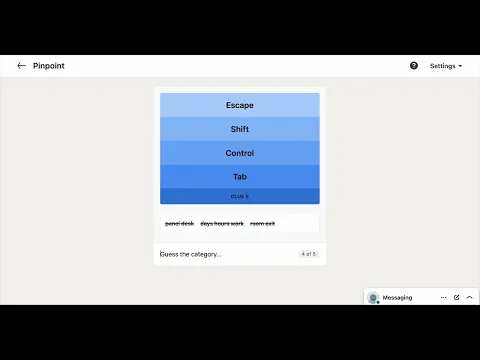
LinkedIn Pinpoint #517 Answer & Analysis
Looking for the Pinpoint #517 answer? Beyond Escape, Shift, Control, Tab, and Backspace, the logic is trickier than you think. It's not about keyboard shortcuts! Get our fast answer and expert logic tips below to save your streak now.
LinkedIn Pinpoint 517 Clues & Answer
💡 Hover (desktop) or tap (mobile) each clue to see how it connects to the answer
#1
Used to cancel actions or exit menus; the "emergency" key of the UI.
#2
Primarily used for capitalization or accessing secondary symbols.
#3
The primary modifier for keyboard shortcuts (Ctrl+C, Ctrl+V).
#4
Controls horizontal spacing and switches between UI elements.
#5
The fundamental tool for deleting characters to the left of the cursor.
Answer: Keys on a keyboard
LinkedIn Pinpoint #517 Expert Logic
1. Introduction
LinkedIn Pinpoint #517 is a masterclass in functional categorization. This specific puzzle challenges players to look past the literal definitions of common verbs and nouns to identify their shared identity as physical inputs. By grouping these specific commands together, the puzzle highlights the evolution of how humans interact with digital machines, moving from simple mechanical actions to complex software navigation.
2. How the Puzzle Came Together
The puzzle logic initiates with Escape and Shift, two words that, in a vacuum, suggest movement or change. However, the introduction of Control immediately refines the search space from "general actions" to "systemic modifiers."
As the player moves to Tab, the theme of digital navigation becomes undeniable. The final clue, Backspace (if not on stands), serves as the definitive anchor. While the parenthetical note "if not on stands" is a rare qualifier for this specific set (likely referencing the physical "backspace" mechanism in vintage typewriters versus modern floating keys), it forces the brain to visualize the physical hardware. Together, these five clues transition from abstract concepts to the tangible Keys on a keyboard we use every second of our professional lives.
3. Category: Pinpoint 517
- A. Core Answer: Keys on a keyboard
- B. Difficulty Rating: 1.8 / 5.0 (The high frequency of these terms in daily office work makes the connection relatively intuitive for most LinkedIn users).
4. Words & How They Fit
Semantic Logic Breakdown
- Modifier Utility: Several clues (Shift, Control) do not produce a character on their own but modify the behavior of other inputs.
- Navigation & Correction: The remaining clues (Escape, Tab, Backspace) manage the "flow" of the cursor or the state of the active window.
Logic Role Classification
| Clue | Logical Role | Why it fits |
|---|---|---|
| Escape | The State Switcher | Used to cancel actions or exit menus; the "emergency" key of the UI. |
| Shift | The Case Modifier | Primarily used for capitalization or accessing secondary symbols. |
| Control | The Command Hub | The primary modifier for keyboard shortcuts (Ctrl+C, Ctrl+V). |
| Tab | The Indentation Tool | Controls horizontal spacing and switches between UI elements. |
| Backspace | The Correction Key | The fundamental tool for deleting characters to the left of the cursor. |
5. Better Analysis Directions
A. Red Herring Analysis (The "Action Verb" Trap)
A novice player might see Escape, Shift, and Control and assume the category is "Management Styles" or "Driving Maneuvers." The expert, however, notices that Tab has no place in those categories. In Pinpoint, if a word has a very specific technical meaning (like Tab), that meaning usually overrides the more common, abstract definitions of the other clues.
B. Historical Pattern (The Peripheral Theme)
LinkedIn Pinpoint frequently features "Office Tech" or "Hardware Components." By recognizing that these are all non-alphanumeric keys, the expert can quickly eliminate "Computer Software" and narrow the answer down to the physical "Keyboard."
C. The Expert Workflow
- Isolate Modifiers: Group Shift and Control immediately.
- Contextualize Navigation: Add Tab and Escape to the "functional command" list.
- Confirm Hardware: Use Backspace to verify that we are talking about a physical input device.
- Synthesize: Define the set not just as "Computer buttons," but specifically as "Keys."
6. Lessons Learned From Pinpoint 517
This puzzle teaches us the importance of Contextual Filtering. Many words in the English language are polysemous (having multiple meanings). To solve Pinpoint efficiently, one must find the "lowest common denominator" of meaning. While "Shift" can mean a work period or a gear change, its only logical connection to "Backspace" is the keyboard.
💡 Trivia: The "Panic" Button: The Origin of the Escape Key
The Escape key (Esc) was created in 1960 by Bob Bemer, an IBM programmer who was tired of different computer languages using different codes for the same thing. He invented the Esc key as a way for programmers to "escape" one type of code and switch to another.
Later, as computers became more mainstream, it evolved into the "cancel" button we know today. Bemer was also a pioneer in warning the world about the Y2K bug—leading some to call him the "Father of the Escape Key" because he spent his career trying to help humanity "escape" from technological disasters!
FAQ
Q: Why are these called "Modifier Keys"? A: Shift and Control are called modifiers because they don't send a character to the computer on their own; instead, they "modify" the output of other keys when held down.
Q: Is "Backspace" the same as "Delete"? A: Technically, no. In the logic of keyboard design, Backspace removes the character before the cursor, while Delete removes the character after the cursor.
Q: Why was the qualifier "(if not on stands)" used? A: This is a subtle nod to the physical mechanics of keys. On very old mechanical typewriters or specialized hardware, the "Backspace" was a heavy physical lever or a key positioned on a specific mounting "stand" or frame.
Watch the logic walkthrough