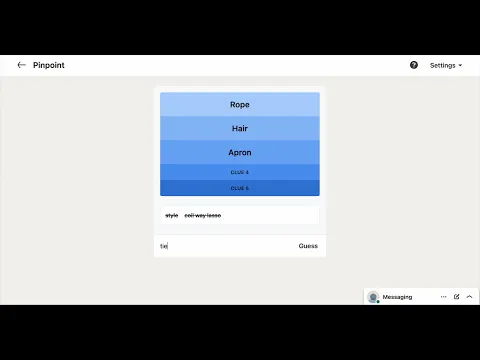
LinkedIn Pinpoint #533 Answer & Analysis
Looking for the Pinpoint #533 answer? Beyond Rope, Hair, Apron, Football (or soccer) game, and Shoelaces, the logic is trickier than you think. It's not about things made of fabric or string! Get our fast answer and expert logic tips below to save your streak now.
LinkedIn Pinpoint 533 Clues & Answer
💡 Hover (desktop) or tap (mobile) each clue to see how it connects to the answer
#1
The most fundamental object associated with the action of tying.
#2
Broadens the category to include organic/personal styling.
#3
Represents clothing that relies specifically on a tie rather than buttons or zippers.
#4
Shifts the logic from a physical knot to a numerical stalemate (a draw).
#5
A universal reference point for a "tie" that everyone performs daily.
Answer: Things that can be tied
LinkedIn Pinpoint #533 Expert Logic
1. Introduction
LinkedIn Pinpoint #533 is a masterclass in linguistic versatility. While most puzzles focus on a single category of objects, this set challenges the player to bridge the gap between physical utility and abstract sports terminology. The common thread is not a location or a material, but a specific action—one that manifests as a physical knot in some cases and a competitive stalemate in others.
2. How the Puzzle Came Together
The logic of this puzzle is built on a "slow burn" of realization. It begins with Rope and Shoelaces (if not on stands), which immediately suggest manual dexterity and utility. Most players will initially think of "knots" or "fasteners." The inclusion of an Apron reinforces this, as the act of donning one almost always requires a bow or a knot at the waist.
However, the puzzle introduces Hair, which shifts the context from "tools" to "personal grooming." You don't just "knot" hair; you secure it. The final piece, a Football (or soccer) game, is the ultimate "pivot clue." It breaks the physical chain entirely. A game cannot be physically knotted, but it can certainly end in a draw. This forces the player to move from the physical noun to the functional verb: "to tie."
3. Category: Pinpoint 533
- A. Core Answer: Things that can be tied
- B. Difficulty Rating: 3.4 / 5.0 (The transition from physical objects to a sports "tie" provides a significant jump in cognitive demand).
4. Words & How They Fit
Semantic Logic Breakdown
- Mechanical Connection: Items like rope and shoelaces require physical manipulation to function.
- Linguistic Polysemy: The word "tie" acts as a homonym, representing both a physical bond and an equal score in a contest.
Logic Role Classification
| Clue | Logical Role | Why it fits |
|---|---|---|
| Rope | The Prototype | The most fundamental object associated with the action of tying. |
| Shoelaces | The Daily Essential | A universal reference point for a "tie" that everyone performs daily. |
| Apron | The Functional Anchor | Represents clothing that relies specifically on a tie rather than buttons or zippers. |
| Hair | The Aesthetic Shift | Broadens the category to include organic/personal styling. |
| Football (or soccer) game | The Semantic Pivot | Shifts the logic from a physical knot to a numerical stalemate (a draw). |
5. Better Analysis Directions
A. Red Herring Analysis (The "Clothing" Trap)
Many players see Apron, Shoelaces, and Hair (accessories) and immediately guess "Things you wear" or "Getting dressed." However, Rope and Football games do not fit this narrow definition. The "Expert" identifies that "Clothing" is a subset, while "Tied" is the overarching mechanism.
B. Historical Pattern (The Verb-Noun Bridge)
Pinpoint frequently uses clues that function as different parts of speech. In #533, four clues are nouns that receive the action, while the fifth (the game) represents the result of the action. Recognizing this "Action-Result" pattern is a hallmark of high-level Pinpoint play.
C. The Expert Workflow
- Identify the Physicality: Note that Rope, Shoelaces, and Aprons all require knots.
- Test the Outlier: Look at Football game. Ask: "What word connects a knot to a score?"
- Verify the Bridge: Does "Tie" work for Hair? Yes (hair ties/tying hair).
- Synthesize: Confirm "Things that can be tied" covers both the literal and the figurative.
6. Lessons Learned From Pinpoint 533
This puzzle teaches us to look for functional verbs when nouns seem disparate. When you encounter a list that includes both a physical object and an event (like a game), the connection is almost always a word that can describe both a physical state and a conceptual outcome.
💡 Trivia: The "Dead Heat" and the Evolution of the Tie
In the world of sports, a "tie" or a "draw" wasn't always a simple matter of equal points. The term "Dead Heat" (often used for tied races) actually comes from 18th-century horse racing. If a race was so close that the judges couldn't determine a winner, the "heat" (the race) was considered "dead" and had to be run again!
Interestingly, the word "tie" in the context of scores likely evolved from the idea of "tying" the two competitors together with a metaphorical string, meaning neither could pull ahead of the other.
FAQ
Q: Why was the qualifier "(if not on stands)" used for Shoelaces? A: This ensures the focus remains on the action of tying. If shoelaces are on a display stand or part of a slip-on shoe design that is "fixed," the necessity of the "tie" is removed. It forces the player to think of the shoelace in its active, functional state.
Q: Can all football games end in a tie? A: Not all. In "knockout" tournaments (like the World Cup playoffs or the NFL playoffs), games must have a winner, leading to extra time or penalty shootouts. However, the possibility of a tie is a defining characteristic of the sport's standard league play.
Watch the logic walkthrough