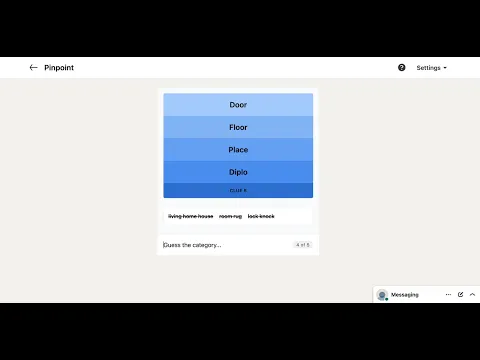
LinkedIn Pinpoint #542 Answer & Analysis
Looking for the Pinpoint #542 answer? Beyond Door, Floor, Place, Diplo, and Laundro, the logic is trickier than you think. It's not about common prefixes or word fragments! Get our fast answer and expert logic tips below to save your streak now.
LinkedIn Pinpoint 542 Clues & Answer
💡 Hover (desktop) or tap (mobile) each clue to see how it connects to the answer
#1
Forms "Doormat"; the most common association with the word "mat."
#2
Forms "Floormat"; keeps the player thinking about floor coverings.
#3
Forms "Placemat"; shifts the context from the floor to the table.
#4
Forms "Diplomat"; breaks the "physical rug" pattern and requires suffix logic.
#5
Forms "Laundromat"; the parenthetical "if not on stands" ensures you think of the word, not just the rug.
Answer: Terms that come before 'mat'
LinkedIn Pinpoint #542 Expert Logic
1. Introduction
LinkedIn Pinpoint #542 is a masterclass in linguistic morphology. This puzzle challenges players to transition from concrete, physical objects found in a household to abstract professional titles and commercial spaces. The unifying thread isn't a shared location or function, but a specific four-letter suffix that transforms these fragments into complete, recognizable nouns.
2. How the Puzzle Came Together
The puzzle construction begins with the "Physical Trio": Door, Floor, and Place. These clues are designed to lead the player toward home textiles. A Door and a Floor both naturally pair with a protective covering, while a Place setting at a dinner table requires its own specific surface protection.
However, the logic takes a sophisticated turn with Diplo. This fragment is purely linguistic; it cannot stand alone in this context, forcing the player to abandon the "physical rug" theory and move toward word construction. The final clue, Laundro (if not on stands), acts as the definitive anchor. By adding the playful qualifier "(if not on stands)," the puzzle creator winks at the player: while a "mat" usually lies flat on the ground, the word "Laundromat" represents an entire establishment. This shift from "object" to "suffix" is the "Aha!" moment required to solve the set.
3. Category: Pinpoint 542
- A. Core Answer: Terms that come before 'mat'
- B. Difficulty Rating: 3.8 / 5.0 (The jump from physical household items to the Greek-rooted "Diplo" creates a significant cognitive hurdle).
4. Words & How They Fit
Semantic Logic Breakdown
- Homonymic Suffix: The puzzle exploits the fact that "mat" can refer to a physical rug (Doormat) or a suffix derived from "automatic" (Laundromat) or "mátos" (Diplomat).
- Compound Construction: Each clue serves as the "prefix" or "headword" that requires the "mat" tail to achieve semantic completeness.
Logic Role Classification
| Clue | Logical Role | Why it fits |
|---|---|---|
| Door | The "Easy" Entry | Forms "Doormat"; the most common association with the word "mat." |
| Floor | The Reinforcer | Forms "Floormat"; keeps the player thinking about floor coverings. |
| Place | The Pivot | Forms "Placemat"; shifts the context from the floor to the table. |
| Diplo | The Linguistic Hurdle | Forms "Diplomat"; breaks the "physical rug" pattern and requires suffix logic. |
| Laundro | The Logical Anchor | Forms "Laundromat"; the parenthetical "if not on stands" ensures you think of the word, not just the rug. |
5. Better Analysis Directions
A. Red Herring Analysis (The "Home Goods" Trap)
Many players likely guessed "Types of Rugs" or "Floor Coverings" after seeing the first three clues. The "Expert" player recognizes that Diplo and Laundro are not types of fabric or flooring. This realization forces a pivot from thematic grouping (things in a house) to lexical grouping (word endings).
B. Historical Pattern (Suffix Puzzles)
Pinpoint frequently utilizes "The Blank Filler" logic. Historically, when a clue ends in a non-word or a fragment (like Diplo or Laundro), the answer is almost always a suffix or a compound word component. Puzzle #542 follows the established pattern of mixing common nouns with Greek/Latin roots to balance difficulty.
C. The Expert Workflow
- Identify the Pattern: Note that Door, Floor, and Place all precede "mat."
- Test the Hypothesis: Apply "mat" to Diplo. "Diplomat" is a valid word.
- Validate the Qualifier: Check Laundro. "Laundromat" fits. The note "if not on stands" confirms we are looking for the word "mat," differentiating the suffix from the physical object.
- Synthesize: Define the relationship as "Terms that come before 'mat'."
6. Lessons Learned From Pinpoint 542
This puzzle teaches us to decouple meaning from structure. While a doormat and a diplomat have nothing in common functionally, they are identical structurally. When you encounter a clue that isn't a standalone word (like Diplo), immediately switch your brain from "What is this?" to "What completes this?"
💡 Trivia: The "Automatic" Origin of the Laundromat
The term Laundromat was actually a trademarked brand name! It was coined in the 1940s by Westinghouse Electric Corporation.
The suffix "-mat" in this context was a shorthand for "automatic." Following the success of the "Automats" (self-service restaurants), the "-mat" suffix became a mid-century linguistic trend to signify high-tech, self-service convenience. This is why a Diplomat (from the Greek diploma, meaning "folded paper") and a Laundromat (from "Laundry" + "Automatic") share a suffix despite having completely different etymological bloodlines!
FAQ
Q: Why was the "if not on stands" hint included for Laundro? A: It’s a clever linguistic joke. A "mat" (the object) is usually on the floor. If a "Laundro-mat" were "on stands" (like a kiosk), it would break the physical definition of a mat. It’s a hint to focus on the word rather than the object.
Q: Is "Diplo" a real word? A: Not in this context. It is a prefix derived from the Greek diploos, meaning "double." It only becomes the person-focused noun we know when the suffix "-mat" is added.
Watch the logic walkthrough