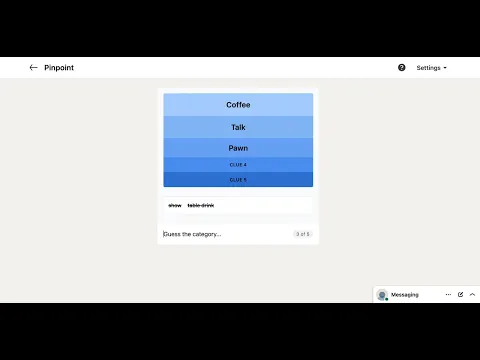
LinkedIn Pinpoint #564 Answer & Analysis
Looking for the Pinpoint #564 answer? Beyond Coffee, Talk, Pawn, Thrift, and Like a bull in a china, the logic is trickier than you think. It's not about types of businesses or common expressions! Get our fast answer and expert logic tips below to save your streak now.
LinkedIn Pinpoint 564 Clues & Answer
💡 Hover (desktop) or tap (mobile) each clue to see how it connects to the answer
#1
Highly recognizable; "Coffee shop" is a ubiquitous daily-life term.
#2
Forces the player to stop thinking only of buildings and start thinking of phrases.
#3
Connects retail to financial services, narrowing the "store" vs. "shop" distinction.
#4
Reinforces the idea of a physical store or "shop."
#5
Uses a famous simile to lock in the word "shop" as the missing component.
Answer: Words that come before 'shop'
LinkedIn Pinpoint #564 Expert Logic
1. Introduction
LinkedIn Pinpoint #564 is a masterclass in linguistic versatility. At first glance, the clues seem to span disparate worlds—from your morning caffeine routine to financial transactions and even clumsy metaphors. However, the connective tissue isn't a shared physical space or a category of objects, but a specific linguistic "suffix" that transforms each word into a distinct destination or idiom.
2. How the Puzzle Came Together
The logic of this puzzle is built on the "Blank Filler" mechanic. It begins with Coffee and Thrift, two words that immediately evoke the retail landscape. Most players will quickly associate these with "stores," but the puzzle deepens the challenge by introducing Pawn. While a pawn shop is a business, it carries a different financial connotation than a typical retail outlet.
The difficulty spikes with the introduction of Talk. Unlike the others, "Talk shop" is an idiom meaning to discuss one's work outside of professional hours, shifting the logic from physical locations to figurative language. Finally, the puzzle provides a colorful anchor: Like a bull in a china (if not on stands). This clue relies on the player recognizing the famous idiom "a bull in a china shop." The parenthetical "if not on stands" acts as a clever, albeit slightly confusing, qualifier to ensure the player focuses on the word "China" as a precursor to "shop."
3. Category: Pinpoint 564
- A. Core Answer: Words that come before 'shop'
- B. Difficulty Rating: 2.8 / 5.0 (The mix of literal businesses and idiomatic phrases provides a moderate challenge).
4. Words & How They Fit
Semantic Logic Breakdown
- Retail/Physical Spaces: Coffee, Thrift, and Pawn represent brick-and-mortar establishments.
- Idiomatic Expressions: "Talk shop" and "China shop" move the logic into the realm of metaphors and common sayings.
Logic Role Classification
| Clue | Logical Role | Why it fits |
|---|---|---|
| Coffee | The Gateway Clue | Highly recognizable; "Coffee shop" is a ubiquitous daily-life term. |
| Thrift | The Retail Anchor | Reinforces the idea of a physical store or "shop." |
| Pawn | The Niche Bridge | Connects retail to financial services, narrowing the "store" vs. "shop" distinction. |
| Talk | The Abstract Pivot | Forces the player to stop thinking only of buildings and start thinking of phrases. |
| Like a bull in a china | The Idiomatic Anchor | Uses a famous simile to lock in the word "shop" as the missing component. |
5. Better Analysis Directions
A. Red Herring Analysis (The "Small Business" Trap)
Many players might initially guess "Types of Stores" or "Small Businesses." While "Coffee," "Thrift," and "Pawn" fit this, "Talk" and "Like a bull in a china" do not. The "Expert" identifies that the link must be linguistic (a shared word) rather than categorical (a shared type of entity).
B. Historical Pattern (Compound Construction)
Pinpoint frequently utilizes the "Suffix/Prefix" pattern. In the game's history, when clues range from very literal (Coffee) to very figurative (Talk), the solution is almost always a word that completes a compound phrase. This is a common tactic to ensure the puzzle isn't solved too instantly.
C. The Expert Workflow
- Identify the Commonality: Notice that Coffee and Thrift both pair perfectly with "shop."
- Test the Hypothesis: Does "Pawn shop" work? Yes.
- Check for Exceptions: How does "Talk" fit? "Talk shop" is a common idiom.
- Confirm with the Qualifier: "Bull in a china shop" confirms the logic, with the parenthetical note serving to isolate "China" as the key word.
6. Lessons Learned From Pinpoint 564
This puzzle teaches us to look for functional linguistic glue. When faced with a list that includes both physical objects and abstract actions (like "Talk"), the connection is usually found in how those words are used in common parlance. Always test a suspected "link word" against the most abstract clue first to see if it holds up.
💡 Trivia: The Symbolism of the Pawn Shop
While most "shops" in this list have varied signage, the Pawn shop has one of the oldest and most consistent logos in history: The Three Golden Balls.
Legend suggests this symbol originated with the Medici family of Florence, a powerful banking dynasty. The three spheres were originally part of their coat of arms (representing coins or medicinal pills). Because the Medicis were so influential in early finance and moneylending, other lenders adopted the three balls to signal their profession. Today, it remains a universal shorthand for a pawn shop, proving that a good "shop" brand can last for over 500 years!
FAQ
Q: Why is "Talk" included if it's not a physical shop? A: Pinpoint often mixes literal and figurative clues to increase difficulty. "Talk shop" is a widely recognized phrase that uses "shop" in a non-spatial way.
Q: What does "if not on stands" mean for the China clue? A: This is likely a playful qualifier. If "China" (the ceramic) is not displayed on stands, it is usually sitting on shelves in a "China shop," making it vulnerable to the proverbial "bull."
Watch the logic walkthrough