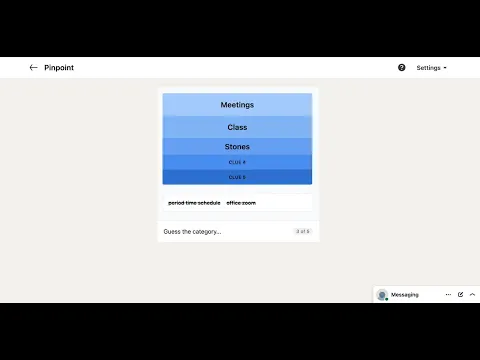
LinkedIn Pinpoint #565 Answer & Analysis
Looking for the Pinpoint #565 answer? Beyond Meetings, Class, Stones, Lines, and Ropes (when at the playground), the logic is trickier than you think. It's not about things you find in a specific setting! Get our fast answer and expert logic tips below to save your streak now.
LinkedIn Pinpoint 565 Clues & Answer
💡 Hover (desktop) or tap (mobile) each clue to see how it connects to the answer
#1
Represents the "avoidance" definition of skip in a work context.
#2
A classic example of "skipping" (truancy) that most players recognize instantly.
#3
Shifts the logic from "not attending" to the physical action of skipping across water.
#4
Refers to skipping a line in a queue or a line of dialogue/text.
#5
Specifically refers to "jump rope" (skipping rope) in a playground setting.
Answer: Things you can skip
LinkedIn Pinpoint #565 Expert Logic
1. Introduction
LinkedIn Pinpoint #565 is a masterclass in linguistic polysemy—the capacity for a single word to have multiple related meanings. This puzzle challenges players to look past the literal definitions of the clues and identify a shared action. While the items range from professional obligations to physical objects, they are all unified by a single, versatile verb that describes how we interact with them.
2. How the Puzzle Came Together
The puzzle logic begins with Meetings and Class, which immediately suggest a theme of "Obligations" or "Schedule." Most players initially think of "Things you attend" or "Things you can be late for." However, the introduction of Stones creates a sharp cognitive pivot. You don't "attend" a stone; you throw it. This forces the mind to find a verb that applies to both social avoidance and physical motion.
The logic deepens with Lines. In a professional or literary context, you might skip a line of text, or in a social context, skip a line in a queue. The final clue, Ropes (when at the playground), serves as the physical anchor. By adding the qualifier (if not on stands) to the broader set, the puzzle clarifies that we are looking for the action of "skipping." Whether it is skipping a dull meeting or skipping a stone across a lake, the verb "skip" acts as the connective tissue across disparate domains of life.
3. Category: Pinpoint 565
- A. Core Answer: Things you can skip
- B. Difficulty Rating: 3.8 / 5.0 (The leap from "skipping a meeting" to "skipping a stone" requires a high level of lateral thinking).
4. Words & How They Fit
Semantic Logic Breakdown
- Intentional Absence: Skipping as a choice to not participate (Meetings, Class).
- Kinetic Motion: Skipping as a physical interaction with an object (Stones, Ropes).
- Procedural Shortcut: Skipping as a way to bypass a sequence (Lines).
Logic Role Classification
| Clue | Logical Role | Why it fits |
|---|---|---|
| Meetings | Professional Pivot | Represents the "avoidance" definition of skip in a work context. |
| Class | Academic Anchor | A classic example of "skipping" (truancy) that most players recognize instantly. |
| Stones | Kinetic Distractor | Shifts the logic from "not attending" to the physical action of skipping across water. |
| Lines | Sequential Link | Refers to skipping a line in a queue or a line of dialogue/text. |
| Ropes | The Activity Key | Specifically refers to "jump rope" (skipping rope) in a playground setting. |
5. Better Analysis Directions
A. Red Herring Analysis (The "School" Trap)
The most dangerous red herring in #565 is the "School/Education" theme. With Class, Ropes (gym class), and Lines (lining up), players often get stuck searching for school-related answers. The "Expert" avoids this by testing the word Stones against the school theme; since "Stones" doesn't fit a standard educational category, the theme must be broader—likely an action verb.
B. Historical Pattern (The Polysemy Pivot)
Pinpoint frequently uses clues that satisfy different definitions of the same word. In historical data, puzzles that mix abstract concepts (Meetings) with physical objects (Stones) almost always point to a Verb Bridge. Recognizing this pattern allows experts to stop looking for a "category of things" and start looking for a "category of actions."
C. The Expert Workflow
- Identify the Conflict: Note that Meetings and Stones have almost zero physical or categorical overlap.
- Search for the Verb: Test verbs that fit both: "Throw"? (No). "Miss"? (Maybe). "Skip"? (Yes).
- Validate the Remainder: Does "skip" work for Class? Yes. For Lines? Yes. For Ropes? Yes.
- Refine with Context: Use the "playground" and "not on stands" qualifiers to confirm the specific usage of the verb.
6. Lessons Learned From Pinpoint 565
This puzzle teaches us that qualifiers are clues, not just flavor text. The mention of "if not on stands" for lines or ropes is a hint to differentiate between a physical barrier (which you might trip over) and a sequence or activity you can bypass. When stuck, always look for the "odd one out" (like Stones) to break your initial logical bias.
💡 Trivia: The Physics of the Perfect Skip
Regarding the Stones mentioned in this puzzle, there is actually a scientific "magic number" for skipping them. Research from the University of Lyon discovered that the secret to the maximum number of skips is the 20-degree angle.
If a stone hits the water at exactly 20 degrees relative to the surface, it minimizes the time it spends in contact with the water, maximizing the transfer of vertical force into a "jump." The world record for skipping a stone is currently 88 skips, set by Kurt Steiner in 2013. So, the next time you "skip" out on a Meeting, perhaps head to a lake and practice your 20-degree entry!
FAQ
Q: Why the "if not on stands" qualifier? A: This likely refers to "Lines." If a line is held by stanchions (stands), it is a physical barrier. If it is just a concept or a row of text, it is something you can "skip" over more easily.
Q: Is "skipping" a class different from "missing" a class? A: Yes. In the context of this puzzle, "skip" implies an intentional act of bypassing, which aligns with the kinetic action of skipping a stone or a rope.
Watch the logic walkthrough