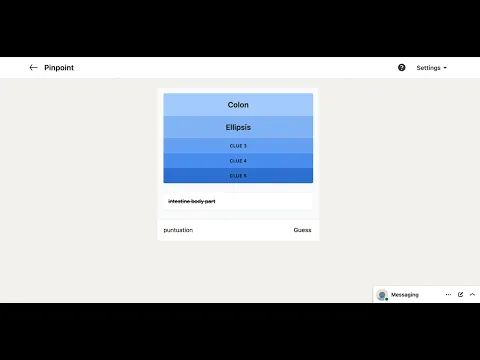
LinkedIn Pinpoint #567 Answer & Analysis
Looking for the Pinpoint #567 answer? Beyond Colon, Ellipsis, Morse code, Pointillist paintings, and Lowercase i's and j's, the logic is trickier than you think. It's not about just about punctuation marks! Get our fast answer and expert logic tips below to save your streak now.
LinkedIn Pinpoint 567 Clues & Answer
💡 Hover (desktop) or tap (mobile) each clue to see how it connects to the answer
#1
A literal representation of two vertical dots used to introduce information.
#2
Represents an omission or a pause, visually constructed of three consecutive dots.
#3
Uses "dots" and "dashes" as the primary alphabet for long-distance signaling.
#4
Refers to the technique of using small, distinct dots of color to form an image (e.g., Seurat).
#5
Focuses on the "tittle," the small diacritic dot that distinguishes these lowercase letters.
Answer: Things with dots
LinkedIn Pinpoint #567 Expert Logic
1. Introduction
LinkedIn Pinpoint #567 is a masterclass in visual reductionism. It challenges players to look past the functional utility of language, art, and communication to identify a shared physical atom: the dot. From the rhythmic pulses of 19th-century telegraphy to the precise punctuation of a modern sentence, this puzzle weaves together disparate fields through a singular geometric constraint.
2. How the Puzzle Came Together
The logical journey of Pinpoint #567 begins in the realm of grammar. A Colon and an Ellipsis provide the initial breadcrumbs; both are punctuation marks defined entirely by their "dot" count (two and three, respectively). However, the puzzle quickly pivots away from linguistics to test the player’s breadth of knowledge.
By introducing Morse code, the logic shifts from static punctuation to dynamic communication, where the "dot" (or dit) serves as a foundational binary unit. The complexity increases with Pointillist paintings, a nod to the Neo-Impressionist movement where dots of color blend in the viewer's eye to create an image. Finally, the inclusion of Lowercase i's and j's (if not on stands) acts as the linguistic anchor. This clue is particularly clever because it highlights the "tittle"—the technical name for those specific dots—while the qualifier "if not on stands" ensures the player focuses on the standard typographic form rather than stylized or capital versions. Together, these clues move from the micro (a single letter) to the macro (a full-scale painting), all bound by the same visual element.
3. Category: Pinpoint 567
- A. Core Answer: Things with dots
- B. Difficulty Rating: 2.8 / 5.0 (While the connection is visual, "Pointillist" and the specific anatomy of "i and j" require a moment of deeper reflection).
4. Words & How They Fit
Semantic Logic Breakdown
- Graphical Components: Every clue describes an entity that is physically composed of, or characterized by, small circular marks.
- Scale Invariance: The "dots" range from microscopic ink on a page to visible brushstrokes on a canvas.
Logic Role Classification
| Clue | Logical Role | Why it fits |
|---|---|---|
| Colon | Punctuation Anchor | A literal representation of two vertical dots used to introduce information. |
| Ellipsis | Sequential Logic | Represents an omission or a pause, visually constructed of three consecutive dots. |
| Morse code | Systemic Unit | Uses "dots" and "dashes" as the primary alphabet for long-distance signaling. |
| Pointillist paintings | Stylistic Expansion | Refers to the technique of using small, distinct dots of color to form an image (e.g., Seurat). |
| Lowercase i's and j's | The Typographic Key | Focuses on the "tittle," the small diacritic dot that distinguishes these lowercase letters. |
5. Better Analysis Directions
A. Semantic Trap: The "Punctuation" Red Herring
The most common pitfall in #567 is identifying the first two clues and assuming the answer is "Grammar Marks." While a Colon and Ellipsis fit this, Morse code and Pointillist paintings do not. The expert solver realizes that "Punctuation" is too narrow and must look for the physical property that makes those marks unique.
B. Historical Pattern (Physical Attributes)
Pinpoint often utilizes "Component Logic" (e.g., Things with strings, Things with keys). Historical data shows that when clues jump across wildly different industries (Art vs. Telecom vs. Grammar), the link is almost always a physical characteristic rather than a functional one.
C. The Expert Workflow
- Identify the commonality between Colon and Ellipsis (Dots).
- Test the hypothesis against Morse code. (Does Morse code have dots? Yes, dots and dashes).
- Validate with the outlier: Does a Pointillist painting have dots? Yes, it is defined by them.
- Refine with the qualifier: The note on i's and j's confirms the focus is on the specific physical presence of the "tittle."
6. Lessons Learned From Pinpoint 567
This puzzle teaches us to deconstruct objects into their simplest geometric forms. When faced with a list that spans multiple centuries and technologies, ignore what the items do and look at what they are made of. The "if not on stands" qualifier is a classic Pinpoint tactic used to eliminate ambiguity, reminding us that the most specific clue is often the most helpful.
💡 Trivia: The Secret Name of the Dot
The tiny dot over a lowercase "i" or "j" isn't just a "dot"—it has a specific name in typography: the tittle. The word is believed to be a combination of "tiny" and "little."
The phrase "to a T" (meaning exactly right) is actually thought by some linguists to have originated from the expression "jot and tittle," referring to the smallest marks in Hebrew and Greek writing. If you were careful enough to include every "jot" (the smallest letter) and every "tittle" (the smallest stroke or dot), your work was considered perfect!
FAQ
Q: Why was "if not on stands" included for i's and j's? A: This qualifier likely refers to certain display fonts, signage, or architectural "stands" where letters might be stylized or attached to a base, potentially losing the floating dot. It forces the player to think of the standard, written lowercase form.
Q: Is "stippling" the same as "Pointillism"? A: They are very similar! Stippling is a technique using dots of a single color (usually black ink) to create shading, while Pointillism specifically refers to the use of dots of different colors that the eye mixes together. Both, however, would fit the "Things with dots" category.
Watch the logic walkthrough