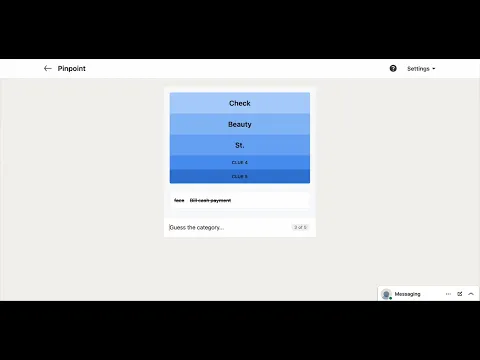
LinkedIn Pinpoint #587 Answer & Analysis
Looking for the Pinpoint #587 answer? Beyond Check, Beauty, St., Deutsche (until replaced by the €), and Question (need a clue: ?), the logic is trickier than you think. It's not about types of punctuation or symbols! Get our fast answer and expert logic tips below to save your streak now.
LinkedIn Pinpoint 587 Clues & Answer
💡 Hover (desktop) or tap (mobile) each clue to see how it connects to the answer
#1
A "Checkmark" (✓) indicates completion or correctness.
#2
A "Beauty mark" is a euphemism for a mole or birthmark, popularized in fashion history.
#3
"St. Mark" refers to Saint Mark the Evangelist, one of the four authors of the Gospels.
#4
The "Deutsche Mark" (DM) was the official currency of West Germany and unified Germany until 2002.
#5
A "Question mark" (?) is the standard punctuation for interrogative sentences.
Answer: Words that come before 'mark'
LinkedIn Pinpoint #587 Expert Logic
1. Introduction
Welcome to the expert strategy breakdown for LinkedIn Pinpoint #587. Today’s puzzle is a masterclass in "Suffix Identification." It challenges players to find a common word that follows five distinct terms to create meaningful compound words or recognized names. This set requires a blend of grammatical knowledge, historical awareness, and a bit of cultural trivia.
2. How the Puzzle Came Together
The logic of #587 is built on a "Progressive Narrowing" mechanism. The journey likely starts with Question and Check, which are the most intuitive linguistic pairings. Most players will immediately think of a "Question mark" or a "Checkmark."
To prevent the puzzle from being too simple, the curators introduced Beauty and St., which shift the context toward physical attributes and religious history. Finally, Deutsche acts as the high-level cognitive anchor. By connecting a punctuation symbol, a facial feature, a former European currency, and a religious figure, the puzzle identifies the hidden thread: the word "Mark."
3. Category: Pinpoint 587
- A. Core Answer: Words that come before “mark”
- B. Difficulty Rating: 3.2 / 5.0 (Moderate. "St." and "Deutsche" require specific knowledge that makes this harder than a standard vocabulary test.)
4. Words & How They Fit
Vocabulary Disassembly
The common thread is the word "Mark" acting as a suffix. The meaning of "Mark" fluctuates from a literal symbol to a currency unit to a proper name.
Logic Role Classification
| Clue (Word) | Logical Role | Why it fits |
|---|---|---|
| Check | Symbolic Indicator | A "Checkmark" (✓) indicates completion or correctness. |
| Beauty | Aesthetic Detail | A "Beauty mark" is a euphemism for a mole or birthmark, popularized in fashion history. |
| St. | Proper Name/Theology | "St. Mark" refers to Saint Mark the Evangelist, one of the four authors of the Gospels. |
| Deutsche | Historical Currency | The "Deutsche Mark" (DM) was the official currency of West Germany and unified Germany until 2002. |
| Question | Grammatical Symbol | A "Question mark" (?) is the standard punctuation for interrogative sentences. |
5. Better Analysis Directions
A. Semantic Trap Breakdown (Red Herring Analysis)
The biggest trap in #587 is the "German/European" theme. Seeing Deutsche and St. (which could mean "Street" or "Saint") might lead a player to think of German locations or cities. However, Beauty and Question are completely incompatible with a geographical theme, forcing the expert to pivot back to a linguistic search.
B. Historical Pattern (Common Suffixes)
LinkedIn Pinpoint frequently uses words with high "combinatorial power." In the history of the game, whenever a proper noun (like St.) or a foreign adjective (like Deutsche) appears, it is a signal to look for a word that transforms them into a well-known entity rather than a general concept.
C. The Expert Workflow
- Isolate the specific: Focus on Deutsche. What word must follow this to make sense? (Mark).
- Verify with the symbols: Does "Mark" work with Check and Question? (Yes).
- Cross-reference the remainder: Does "Beauty mark" and "St. Mark" exist? (Yes).
- Confirm the Answer: Finalize the common suffix as "Mark."
6. Lessons Learned From Pinpoint 587
This puzzle reminds us to treat abbreviations carefully. "St." is a dual-threat clue; it can mean "Street" or "Saint." In Pinpoint, the religious or historical meaning is often the key to unlocking the logic when the literal meaning (Street) fails to connect with other terms like "Question."
💡 Trivia: The Medieval Roots of the Question Mark
The Question Mark (? )—the most recognizable "mark" in this puzzle—has a fascinating origin. Some scholars believe it originated from the Latin word quaestio (meaning "question"). In the Middle Ages, writers would write "Qo" at the end of a sentence to indicate a query. Over time, the "Q" was written on top of the "o," which eventually evolved into the squiggle and dot we use today!
FAQ
Q: Is "St." always for Saint Mark? A: In this puzzle, yes. While "St." often stands for Street, "Street Mark" is not a common idiomatic expression, whereas Saint Mark is a global historical figure.
Q: Does the Deutsche Mark still exist? A: No, it was replaced by the Euro in 2002, but it remains one of the most famous historical currencies in "Mark" related puzzles.
Watch the logic walkthrough