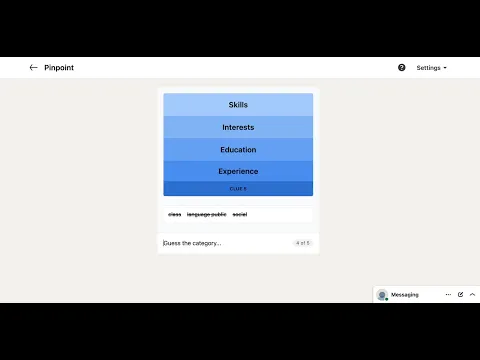
LinkedIn Pinpoint #594 Answer & Analysis
Looking for the Pinpoint #594 answer? Beyond Skills, Interests, Education, Experience, and References (upon request), the logic is trickier than you think. It's not about personal attributes for a job application! Get our fast answer and expert logic tips below to save your streak now.
LinkedIn Pinpoint 594 Clues & Answer
💡 Hover (desktop) or tap (mobile) each clue to see how it connects to the answer
#1
A section dedicated to hard and soft skills (e.g., Python, Leadership).
#2
An optional section describing hobbies to show cultural fit.
#3
Lists degrees, certifications, and institutional history.
#4
The core section detailing work history, titles, and achievements.
#5
A list of contacts who can vouch for the candidate's character and work.
Answer: Parts of a resume
LinkedIn Pinpoint #594 Expert Logic
1. Introduction
Welcome to the strategic analysis of LinkedIn Pinpoint #594. This edition is a masterclass in "Functional Categorization." It challenges players to identify the structural pillars of professional self-presentation. These five terms are the universal building blocks used by millions to tell their career stories and secure their next opportunities.
2. How the Puzzle Came Together
The logic of #594 is built on the standard anatomy of a professional profile. The journey begins with Education and Experience, the two non-negotiable anchors of any candidate’s history. Once these are established, the puzzle introduces Skills, which serves to quantify the candidate’s capabilities.
To add a layer of personality and validation, the puzzle includes Interests and References. While "Interests" offer a glimpse into the human behind the data, "References" provide the third-party trust necessary to close the deal. By grouping these five sections, the puzzle perfectly outlines the standard layout of a Resume (or CV).
3. Category: Pinpoint 594
- A. Core Answer: Parts of a resume
- B. Difficulty Rating: 1.2 / 5.0 (Easy. These terms are ubiquitous in the professional landscape, making the connection highly intuitive.)
4. Words & How They Fit
Semantic Logic Breakdown
The connection is Document Anatomy. Each clue represents a distinct section or "header" used to organize information within a standard resume to ensure readability for recruiters and ATS (Applicant Tracking Systems).
Logic Role Classification
| Clue (Word) | Logical Role | Why it fits |
|---|---|---|
| Skills | Competency List | A section dedicated to hard and soft skills (e.g., Python, Leadership). |
| Interests | Personal Flair | An optional section describing hobbies to show cultural fit. |
| Education | Academic Foundation | Lists degrees, certifications, and institutional history. |
| Experience | Professional Proof | The core section detailing work history, titles, and achievements. |
| References | Social Proof | A list of contacts who can vouch for the candidate's character and work. |
5. Better Analysis Directions
A. Red Herring Analysis (The "LinkedIn Profile" Trap)
The most common "near-miss" answer is "LinkedIn Profile." While a LinkedIn profile contains all these elements, "Resume" is the more traditional and linguistically tight category for this specific set of headers. The "Expert" realizes that Pinpoint often favors the most established, physical-document terminology.
B. Historical Pattern (Career Sets)
LinkedIn frequently features Professional Life themes. In these puzzles, the clues usually represent "Sub-categories" of a larger process (like the hiring process) or "Components" of a professional tool.
C. The Expert Workflow
- Identify the Pair: Education and Experience are almost exclusively seen together in a career context.
- Verify with the List: Do Skills and References fit a career document? Yes.
- Finalize the Container: What is the name of the document that holds these five specific headers? (Resume/CV).
6. Lessons Learned From Pinpoint 594
This puzzle reinforces the importance of Structural Thinking. When you see words that function as "headers" or "labels," your first instinct should be to look for the "container" they belong to—whether it’s a document, a website, or a physical object.
💡 Trivia: The World's First Resume was a "Masterpiece"
Did you know that Leonardo da Vinci is widely credited with writing the first professional resume in history? In 1482, he wrote a letter to Ludovico Sforza, the Duke of Milan, seeking employment. Instead of listing his "Experience" as a painter, he pivoted his "Skills" to focus on military engineering, claiming he could design armored vehicles, portable bridges, and catapults. It worked—he got the job, proving that "tailoring your resume" has been a winning strategy for over 500 years!
FAQ
Q: Is there a difference between a Resume and a CV in this context? A: In most Pinpoint puzzles, the terms are interchangeable. "Resume" is more common in the US, while "CV" is standard in the UK and academia, but both share these five core parts.
Q: Why is "Interests" included if many recruiters say to leave it off? A: While modern trends fluctuate, "Interests" remains a classic, traditional section of the resume template used to create a more well-rounded candidate profile.
Watch the logic walkthrough