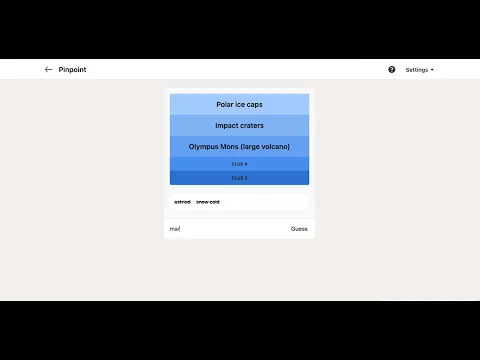
LinkedIn Pinpoint #661 Answer & Analysis
Looking for the Pinpoint #661 answer? Beyond Polar ice caps, Impact craters, Olympus Mons (large volcano), A red sky, and The Curiosity rover, the logic is trickier than you think. It's not about natural phenomena! Get our fast answer and expert logic tips below to save your streak now.
LinkedIn Pinpoint 661 Clues & Answer
💡 Hover (desktop) or tap (mobile) each clue to see how it connects to the answer
#1
Mars has two permanent polar ice caps composed of water ice and solid carbon dioxide.
#2
Like the Moon, Mars' thin atmosphere and lack of plate tectonics preserve millions of craters.
#3
A shield volcano three times the height of Mt. Everest; it is unique to the Martian surface.
#4
Dust in the Martian atmosphere scatters light to create a pinkish-red hue during the day.
#5
One of NASA's most successful missions, currently exploring Gale Crater on Mars.
Answer: Things seen on Mars!
LinkedIn Pinpoint #661 Expert Logic
1. Introduction
LinkedIn Pinpoint #661 takes us on an interplanetary journey, challenging players to identify a specific celestial destination based on its geological and atmospheric characteristics. This puzzle is a masterclass in thematic consistency, utilizing a mix of natural phenomena and man-made technology to pinpoint a location that has captured the human imagination for centuries: the "Red Planet."
2. How the Puzzle Came Together
The puzzle construction follows a narrowing funnel of specificity. It begins with broad planetary features like Polar ice caps and Impact craters. While these could theoretically apply to several bodies in our solar system (like the Moon or even Earth), the scope tightens significantly with the mention of Olympus Mons (large volcano). As the tallest volcano in the solar system, this landmark serves as a definitive geographical anchor.
To ensure the player isn't lost in pure geology, the puzzle introduces the atmospheric element of A red sky, a signature visual of the Martian landscape caused by suspended iron oxide dust. Finally, the inclusion of The Curiosity rover provides a contemporary, technological confirmation. By blending ancient craters with modern robotics, the puzzle builds a comprehensive profile of a single environment, leaving no room for ambiguity.
3. Category: Pinpoint 661
- A. Core Answer: Things seen on Mars!
- B. Difficulty Rating: 1.8 / 5.0 (The combination of "Olympus Mons" and "The Curiosity rover" makes this highly accessible for anyone with basic astronomical knowledge).
4. Words & How They Fit
Semantic Logic Breakdown
- Astro-Geology: Three clues relate to the physical surface and structural history of the planet.
- Atmospheric Optics: One clue focuses on the unique lighting conditions of the environment.
- Exploratory Evidence: One clue highlights the human footprint (or wheel-print) on the terrain.
Logic Role Classification
| Clue | Logical Role | Why it fits |
|---|---|---|
| Polar ice caps | General Characteristic | Mars has two permanent polar ice caps composed of water ice and solid carbon dioxide. |
| Impact craters | Shared Planetary Feature | Like the Moon, Mars' thin atmosphere and lack of plate tectonics preserve millions of craters. |
| Olympus Mons (large volcano) | The Landmark | A shield volcano three times the height of Mt. Everest; it is unique to the Martian surface. |
| A red sky | Visual Signature | Dust in the Martian atmosphere scatters light to create a pinkish-red hue during the day. |
| The Curiosity rover | Anthropogenic Marker | One of NASA's most successful missions, currently exploring Gale Crater on Mars. |
5. Better Analysis Directions
A. Red Herring Analysis (The "Moon" or "Exoplanet" Trap)
A novice player might see Impact craters and immediately think of "The Moon." However, the Moon lacks an atmosphere (A red sky) and active/extinct volcanic systems as massive as Olympus Mons. Similarly, while "Exoplanets" might have these features, the mention of a specific NASA mission like The Curiosity rover grounds the puzzle firmly within our own solar system.
B. Historical Pattern (Location-Based Themes)
Pinpoint frequently uses "Environment Sets" where all clues exist within a specific boundary. In the past, we have seen "Things in a Desert" or "Things in the Arctic." #661 elevates this to a planetary scale. The "Expert" recognizes that when a list includes a specific proper noun (Olympus Mons) alongside general features (Ice caps), the answer is almost always a specific location.
C. The Expert Workflow
- Identify the Anchor: Spot "Olympus Mons"—this is a unique identifier for Mars.
- Verify the Vibe: Check if "Red sky" and "Curiosity rover" align. Both are iconic Martian traits.
- Check for Outliers: Do "Polar ice caps" and "Impact craters" fit? Yes, they are standard Martian geography.
- Synthesize: The common thread is the visual or physical presence on the planet Mars.
6. Lessons Learned From Pinpoint 661
This puzzle highlights the importance of proper nouns as shortcuts. While "Impact craters" is a broad term, "Olympus Mons" is a "High-Value Clue" that instantly solves the puzzle for those with the relevant knowledge. When playing Pinpoint, always look for the most specific word in the set first; it usually holds the key to the entire category.
💡 Trivia: The "Blue" Secret of the Red Sky
While the Martian sky is famous for being A red sky during the day, the sunsets are the complete opposite of Earth's. On Earth, the sky is blue during the day and turns red at sunset. On Mars, because the fine dust particles are just the right size to allow blue light to penetrate the atmosphere more efficiently, the area around the sun appears blue at sunset! If you were standing next to The Curiosity rover at dusk, you would see a pale blue sun sinking into a pinkish horizon.
FAQ
Q: Is Olympus Mons still active? A: No, it is a dormant shield volcano. However, its massive size is possible because Mars does not have tectonic plates, allowing the volcano to sit over a "hotspot" for billions of years and grow to incredible heights.
Q: Are the Polar ice caps made of water? A: Yes, partially. They are a mixture of water ice and "dry ice" (frozen carbon dioxide). The CO2 freezes and thaws with the seasons, while the water ice remains permanent.
Q: Why is the sky red if there is so little oxygen? A: The red color isn't from the gas in the atmosphere, but from the dust. The surface of Mars is covered in iron oxide (rust), and global dust storms kick these particles high into the atmosphere, where they scatter red light.
Watch the logic walkthrough