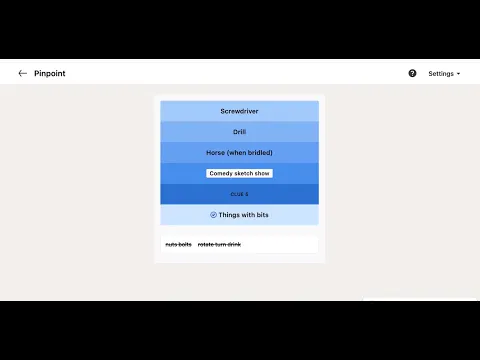
LinkedIn Pinpoint #662 Answer & Analysis
Looking for the Pinpoint #662 answer? Beyond Screwdriver, Drill, Horse (when bridled), Comedy sketch show, and Computer memory (groups of 64), the logic is trickier than you think. It's not about things that perform specific functions! Get our fast answer and expert logic tips below to save your streak now.
LinkedIn Pinpoint 662 Clues & Answer
💡 Hover (desktop) or tap (mobile) each clue to see how it connects to the answer
#1
Uses a "driver bit" to match different screw heads (Phillips, flat, etc.).
#2
Requires a "drill bit" to cut into materials; the bit is the active cutting edge.
#3
The "bit" is the metal bar in the horse's mouth used by the rider to communicate.
#4
A "bit" refers to a specific gag, routine, or short comedic segment.
#5
Refers to "binary digits" (bits). 64-bit architecture is the modern standard for processing data.
Answer: Things with bits!
LinkedIn Pinpoint #662 Expert Logic
1. Introduction
LinkedIn Pinpoint #662 is a masterclass in linguistic polysemy—the phenomenon where a single word carries multiple, distinct meanings across different industries. This puzzle challenges players to look past the physical utility of hardware tools and find the hidden thread connecting equestrian equipment, digital architecture, and performing arts. Success here requires a "multilingual" brain capable of switching from a construction site to a computer lab in seconds.
2. How the Puzzle Came Together
The logic of this puzzle unfolds through a series of functional shifts. It starts in the workshop with the Screwdriver and Drill, two tools that are essentially useless without their interchangeable tips. While "Hardware" or "Construction" might be the first thought, the puzzle immediately pivots to the stable with the Horse (when bridled). Here, the connection isn't about construction, but about the specific metal mouthpiece used for control.
The complexity increases as we move into the abstract. A Comedy sketch show doesn't have physical parts, but it relies on a "bit"—a self-contained routine or joke. Finally, the puzzle enters the digital realm with Computer memory (groups of 64). By referencing the fundamental unit of binary data, the logic is "locked." Whether physical, metaphorical, or digital, every single clue relies on the existence of a "bit" to function or be defined.
3. Category: Pinpoint 662
- A. Core Answer: Things with bits!
- B. Difficulty Rating: 3.8 / 5.0 (The transition from physical tools to abstract comedy routines creates a significant leap in logic).
4. Words & How They Fit
Semantic Logic Breakdown
- Mechanical Interchangeability: In tools, a bit is a modular component designed for specific tasks (boring holes or driving screws).
- Linguistic Units: In entertainment and computing, a "bit" represents the smallest divisible unit of a performance or a piece of information.
Logic Role Classification
| Clue | Logical Role | Why it fits |
|---|---|---|
| Screwdriver | Physical Component | Uses a "driver bit" to match different screw heads (Phillips, flat, etc.). |
| Drill | Physical Component | Requires a "drill bit" to cut into materials; the bit is the active cutting edge. |
| Horse (when bridled) | Specialized Terminology | The "bit" is the metal bar in the horse's mouth used by the rider to communicate. |
| Comedy sketch show | Abstract Metaphor | A "bit" refers to a specific gag, routine, or short comedic segment. |
| Computer memory (groups of 64) | Technical Definition | Refers to "binary digits" (bits). 64-bit architecture is the modern standard for processing data. |
5. Better Analysis Directions
A. Red Herring Analysis (The "Tools" Trap)
The most common mistake in #662 is focusing too heavily on the first two clues. Screwdriver and Drill strongly suggest a "Toolbox" or "DIY" theme. Players often get stuck trying to force "Horse" or "Comedy" into a mechanical context (e.g., "workhorse" or "mechanical comedy"). The "Expert" recognizes that when clues span vastly different fields (Animal Husbandry vs. Software Engineering), the link is almost always a homonym.
B. Historical Pattern (The "Unit" Logic)
Pinpoint frequently uses the "Smallest Unit" logic. Much like puzzles focusing on "Links" (chains, golf, websites) or "Keys" (pianos, locks, maps), "Bits" represents a recurring trope where the game designers test your ability to see a word's versatility across the physical and digital worlds.
C. The Expert Workflow
- Identify the Pair: Recognize that Screwdriver and Drill both use "bits."
- Test the Theory: Apply "bit" to the most disparate clue (Computer memory). "64-bit memory" is a standard tech term, confirming the theory.
- Bridge the Gap: Check the remaining clues. A "comedy bit" is common parlance; a "horse bit" is a specific piece of tack.
- Finalize: Ensure the plural/singular form matches the prompt's requirements.
6. Lessons Learned From Pinpoint 662
This puzzle teaches us to deconstruct nouns into their sub-components. When you see an object, don't just think about what it does; think about what it contains or requires. If you can't find a categorical link (like "Animals" or "Tools"), look for a linguistic link—a single word that acts as a modular piece of the puzzle itself.
💡 Trivia: The Binary Origin of the "Bit"
While we use the word "bit" to describe small pieces of everything from horseshoes to humor, the computing "bit" has a very specific origin. It was coined by mathematician Claude Shannon in 1948, but he credited his colleague John Tukey for the abbreviation.
Tukey shortened "Binary Digit" to "bit." Interestingly, before "bit" became the standard, other suggested names for the smallest unit of information included the "bigit" and the "binit." We should all be grateful that "64-bit computing" won out over "64-bigit computing"!
FAQ
Q: Why was "when bridled" added to the Horse clue? A: A horse doesn't naturally have a "bit." The bit is part of the bridle (the headgear). This qualifier ensures the logic remains precise—the "bit" is only present in a specific context.
Q: Is a "sketch" the same as a "bit" in comedy? A: Not exactly. A sketch is a written scene, while a "bit" is often a smaller unit of performance, like a specific joke or a recurring character trait. However, in the context of Pinpoint, they are synonymous enough to point to the answer.
Watch the logic walkthrough