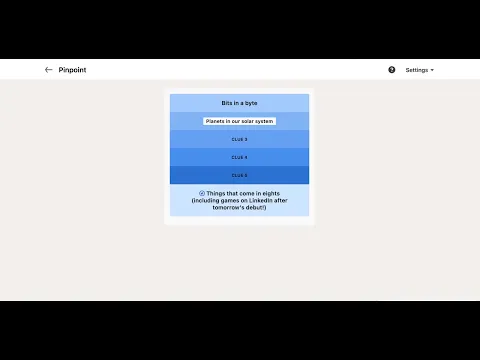
LinkedIn Pinpoint #769 Answer & Analysis
Stuck on LinkedIn Pinpoint 769? What connects Bits in a byte, Planets in our solar system, Legs on a spider, Corners of a cube, and Sides of (most) stop signs—and why? We've got you covered! This elite-level association is a perfect test of your lateral thinking. Try our interactive hints first, then reveal the 30s expert logic and answer below to save your streak!
LinkedIn Pinpoint 769 Clues & Answer
💡 Hover (desktop) or tap (mobile) each clue to see how it connects to the answer
#1
Establishes the numerical pattern (8) within a specific, technical domain, setting the stage.
#2
Confirms the "eight" pattern in a completely different field (astronomy), forcing a shift to abstract thinking.
#3
A classic, well-known "group of eight" that makes the numerical connection undeniable.
#4
Adds a mathematical example, reinforcing that the link is purely abstract and not tied to a single theme.
#5
Brings the pattern into the real world with a common object, making the solution feel complete and satisfying.
Answer: Things that come in eights (including games on LinkedIn after tomorrow's debut!)!
LinkedIn Pinpoint #769 Expert Logic
🧠 Expert Logic Walkthrough
When I saw the first clue, Bits in a byte, my mind immediately jumped to computer science. It’s a foundational concept: a byte is a unit of digital information. The key, of course, is that a standard byte is comprised of eight bits. So, my initial hypothesis was either "tech terms" or something related to the number eight.
Then came clue two: Planets in our solar system. Okay, so much for a simple tech category! This clue rockets us from computing to astronomy. My brain immediately started a roll call: Mercury, Venus, Earth, Mars, Jupiter, Saturn, Uranus, Neptune. That's eight. The key here is remembering that poor Pluto got demoted. The connection isn't a theme; it's a number.
The third clue, Legs on a spider, sealed the deal. From the digital to the cosmic, and now to the biological. Spiders are famously eight-legged arachnids. At this point, I was confident the category had to be "Things that come in eights." The pattern was holding strong across completely unrelated fields, which is the hallmark of a great Pinpoint puzzle.
The last two clues were the victory lap. Corners of a cube is a quick mental check from geometry—yep, a cube has eight vertices. And Sides of (most) stop signs brought it all back to a familiar, everyday object. A stop sign is an octagon, an eight-sided shape. The puzzle elegantly connects the abstract, the natural, and the man-made through one simple number.
Experience & Summary
This is a classic "Specialty Set" puzzle, a common type in Pinpoint. These puzzles challenge you to look past the obvious thematic connections (like "animals" or "tech") and find a more abstract, unifying principle. When you see clues that hop between wildly different domains, put on your lateral thinking hat and ask: "Is there a number, a color, a shape, or another hidden property that links them all?"
🎯 Category: Pinpoint 769
Things that come in eights (including games on LinkedIn after tomorrow's debut!)!
🔍 Semantic Analysis: Bits in a byte, Planets in our solar system & More
| Clue | Logical Role | Why it fits |
|---|---|---|
| Bits in a byte | Technical Anchor | Establishes the numerical pattern (8) within a specific, technical domain, setting the stage. |
| Planets in our solar system | Pattern Broadener | Confirms the "eight" pattern in a completely different field (astronomy), forcing a shift to abstract thinking. |
| Legs on a spider | Biological Solidifier | A classic, well-known "group of eight" that makes the numerical connection undeniable. |
| Corners of a cube | Geometric Confirmation | Adds a mathematical example, reinforcing that the link is purely abstract and not tied to a single theme. |
| Sides of (most) stop signs | Everyday Validator | Brings the pattern into the real world with a common object, making the solution feel complete and satisfying. |
📊 Difficulty Rating
3.8 / 5.0
This puzzle is deceptively tricky. The primary difficulty lies in making the initial leap from the thematic content of the clues to an abstract numerical link. The first clue, Bits in a byte, could be a red herring, leading solvers down a "computer terms" path. Furthermore, the Planets clue is a trap for anyone still counting Pluto, which would incorrectly point toward the number nine.
📜 Historical Pattern
Today’s puzzle is a perfect example of the Specialty Set. This pattern groups items that don't share an obvious thematic category but are linked by a specific, often abstract, characteristic like a number, color, shape, or shared origin. It's about finding the hidden rule.
Similar Pinpoint Examples:
- Pinpoint #621: Canned beverages, Insect legs, Ice hockey players, Sides of a snowflake, Faces on a craps die → Things that come in sixes!
- Pinpoint #516: Primary colors, Little pigs, Blind mice, Musketeers, Books in a trilogy → Things that come in threes
- Pinpoint #723: Ribs in the human body, Blackbirds in a pie (from rhyme), Karats in pure gold, Letters in the Greek alphabet, Hours in a day → Things that come in 24 parts or units!
👉 Learn more about “Specialty Set” pattern.
💡 Lessons Learned From Pinpoint 769
- Pivot to Numbers: When clues jump between wildly different domains (tech, space, biology), your first strategic pivot should be to check for a numerical connection. How many of X are there?
- Knowledge Must Be Current: The puzzle hinges on knowing there are eight planets, not nine. Pinpoint relies on contemporary general knowledge, so don't let outdated facts lead you astray.
- Validate Across All Fields: A strong pattern will hold up across every clue. The "eight" connection worked for computing, astronomy, biology, geometry, and civic design. If a theory only fits three or four clues, it's likely incorrect.
- Don't Ignore Parentheses: The "(most)" in the stop sign clue is a subtle hint about precision. It signals that the puzzle creators are being careful, which should encourage you to be just as precise with your own logic (like counting planets).
🌟 Trivia
The octagonal shape of the stop sign wasn't chosen just for looks. It was designed so that drivers approaching an intersection from the opposite direction could recognize the sign by its unique shape from the back, even in poor lighting or when covered in snow, distinguishing it from all other round or rectangular signs.
🔥 Hot News
The James Webb Space Telescope (JWST) is constantly making headlines by discovering and analyzing exoplanets, expanding our cosmic catalog. This flood of new data on distant worlds reminds us just how special and well-defined our own neighborhood is. The puzzle's clue, Planets in our solar system, serves as a great reminder that while the universe is infinite, our home system has a very specific count—eight—a fact critical for both astronomers and puzzle solvers!
🎬 30s Logic Breakdown
Rapid Recap: Watch our focused logic video below to see the connection in action. We start with the technical concept of "Bits in a byte," bridge it to "Planets in our solar system" via the numerical theme "eight," and then validate it through the diverse worlds of biology, geometry, and civic design. It's a perfect example of how wildly different concepts can be united by a single, abstract number.
👉 Watch the pinpoint 769 video walkthrough.
❓ FAQ
Why aren't there nine planets in our solar system for this puzzle?
In 2006, the International Astronomical Union (IAU) officially reclassified Pluto as a "dwarf planet." This decision reduced the number of recognized planets to eight, which is now the standard for scientific and general knowledge contexts like Pinpoint.
Are there always exactly eight bits in a byte?
Today, yes. The modern standard defines a byte as eight bits (an octet). However, in the early days of computing, the term "byte" was more flexible and could refer to groups of bits of various sizes. The eight-bit standard has long since become universal.
Do all stop signs have eight sides?
The vast majority do, as the octagonal shape is an international standard. The clue cleverly includes "(most)" to account for any rare, non-standard variations that might exist in some specific jurisdictions or historical contexts.
What is a good strategy for number-based Pinpoint puzzles?
When the clues have no obvious thematic link, immediately search for abstract connections. A shared number is the most common type. Count the items in each clue (legs, sides, planets) and see if a pattern emerges. This "lateral thinking" approach is key to solving Specialty Set puzzles.
Watch the logic walkthrough