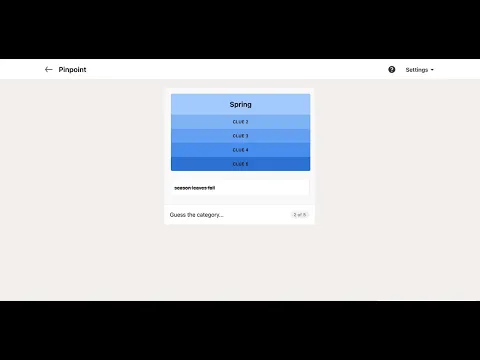
LinkedIn Pinpoint #692 Answer & Analysis
Stuck on LinkedIn Pinpoint 692? What connects Spring, Tap, Oasis, Well, and Fountain—and why? We've got you covered! This clean brand category is a perfect test of your pattern recognition. Try our interactive hints first, then reveal the 30s expert logic and answer below to save your streak!
LinkedIn Pinpoint 692 Clues & Answer
💡 Hover (desktop) or tap (mobile) each clue to see how it connects to the answer
#1
Groundwater naturally emerging to the Earth's surface.
#2
The everyday indoor valve for potable municipal water.
#3
A fertile spot in an arid desert sustained by fresh water.
#4
A deep hole dug or drilled to access liquid resources underground.
#5
A decorative or functional structure pumping drinking water.
Answer: Places to get drinking water!
LinkedIn Pinpoint #692 Expert Logic
🧠 Expert Logic Walkthrough
When you first see Spring, your brain goes in a dozen different directions. Is it the season of blooming flowers? A metal coil inside a mattress? Or maybe a natural pool of water? It’s a classic polysemic word that demands more context.
My initial thought got a little tangled when Tap showed up. Honestly, I briefly wondered if we were looking at types of dance. A "tap" dance, a "spring" in your step? Or maybe physical actions, like tapping a keg or springing a trap. It felt a bit loose, so I held off on committing to any single theory.
That’s where it clicked with the arrival of Oasis. You can’t dance an oasis! Suddenly, the desert imagery wiped the slate clean. An oasis is a haven of water in a dry place. Looking back at the first two clues through this new lens, a Spring provides fresh water from the earth, and a Tap gives you water in your kitchen. We were clearly looking at sources of hydration.
Dropping Well and Fountain into the mix just felt like a victory lap. You dig a well to hit the water table, and you build a fountain to pump it out for public drinking (or wishing coins, but I digress). The connection was undeniable.
Experience & Summary: The trap in this puzzle was the multiple meanings of the early words. The trick to lateral thinking games is recognizing when a new piece of evidence (like the desert refuge) completely invalidates your early assumptions. Once the elemental theme of water emerged, the puzzle solved itself.
🎯 Category: Pinpoint 692
Places to get drinking water!
🔍 Semantic Analysis: Spring, Tap & More
| Clue | Logical Role | Why it fits |
|---|---|---|
| Spring | Natural Source | Groundwater naturally emerging to the Earth's surface. |
| Tap | Domestic Dispenser | The everyday indoor valve for potable municipal water. |
| Oasis | Desert Refuge | A fertile spot in an arid desert sustained by fresh water. |
| Well | Excavated Source | A deep hole dug or drilled to access liquid resources underground. |
| Fountain | Architectural Feature | A decorative or functional structure pumping drinking water. |
📊 Difficulty Rating
1.5 / 5.0
This was a relatively breezy puzzle. The only slight hesitation comes at the very beginning, as the first two clues could technically be verbs, actions, or unrelated nouns. However, there are no aggressive red herrings, and the third clue instantly cements the category for anyone familiar with basic geography and household plumbing.
📜 Historical Pattern
We are looking at the Specialty Set pattern. This is one of Pinpoint's favorite ways to test categorical knowledge, where every clue is a different physical variation of a core, overarching concept—in this case, locations or objects where humans extract water.
Similar Pinpoint Examples:
- Pinpoint #547: Hot, Spring, Fresh, Sparkling, Distilled → Types of water
- Pinpoint #608: Goblet, Mug, Cup, Glass, Bottle → Containers for drinks
- Pinpoint #651: Eyjafjallajökull, Mauna Loa, Fuji, Krakatoa, Vesuvius → Names of volcanoes!
👉 Learn more about “Specialty Set” pattern.
💡 Lessons Learned From Pinpoint 692
- Embrace the polysemy early: Words with multiple meanings are standard issue. Keep all definitions loaded in your mental RAM until the third clue forces a specific context.
- Look for the elemental tie: When words seem functionally different (a metal indoor fixture vs. a desert paradise), strip them down to their core element. Here, that shared core is simply H2O.
- Don't overcomplicate the obvious: If the clues point directly to everyday physical objects or geographic locations, the answer is usually a highly tangible, straightforward category.
🌟 Trivia
Did you know the largest oasis in the world is the Al-Ahsa Oasis in Saudi Arabia? It boasts over 2.5 million date palm trees and is sustained by a massive, ancient underground aquifer—essentially acting as a gigantic, natural spring in the middle of a harsh desert environment!
🔥 Hot News
Recently, city officials in Rome have been debating charging a ticketing fee for tourists to visit the iconic Trevi Fountain to manage massive, overwhelming crowds. This highlights a fascinating cultural shift: what was originally designed as a basic public tap at the end of an ancient Roman aqueduct has evolved into a priceless, must-see oasis that now requires modern crowd control.
🎬 30s Logic Breakdown
Rapid Recap: Watch our focused logic video below to see the connection in action. We start with the natural concept of "Spring," bridge it to "Tap" via the thematic "Places to get drinking water!," and then validate it through the diverse worlds of desert geography, rural drilling, and urban architecture. It's a perfect example of how seemingly unrelated environments all serve the same fundamental human need for hydration.
👉 Watch the pinpoint 692 video walkthrough.
❓ FAQ
Why is "Tap" considered a place to get water?
While a tap is technically a mechanical valve, in everyday vernacular, "going to the tap" refers to the specific physical location at a sink where potable municipal water is dispensed.
Are all oases sources of drinking water?
Yes! By geographical definition, an oasis is a fertile area in a desert environment that is only sustained because of a reliable freshwater source, typically an underground spring.
Could the answer have been related to jumping or dancing?
Initially, the first two clues might suggest kinetic movements or dance styles (like a tap dance or a spring in your step), but the introduction of the third clue completely rules out that logic path.
What makes this puzzle a "Specialty Set"?
It groups specific nouns based on a shared physical function—in this case, providing humans with a mechanism or location to access an essential resource.
Watch the logic walkthrough