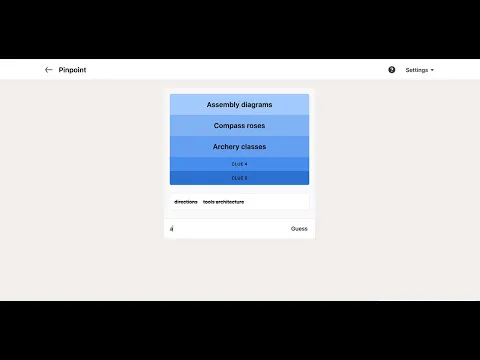
LinkedIn Pinpoint #761 Answer & Analysis
Stuck on LinkedIn Pinpoint 761? What connects Assembly diagrams, Compass roses, Archery classes, One-way street signs, and Bottom right of your keyboard—and why? We've got you covered! This elite-level association is a perfect test of your lateral thinking. Try our interactive hints first, then reveal the 30s expert logic and answer below to save your streak!
LinkedIn Pinpoint 761 Clues & Answer
💡 Hover (desktop) or tap (mobile) each clue to see how it connects to the answer
#1
These technical drawings use arrows to show how different parts connect and in which direction.
#2
The points on a map's compass are stylized arrows indicating the cardinal directions.
#3
This is the lynchpin clue, representing the physical object itself—an arrow used in a sport.
#4
A clear, universally understood arrow dictates the mandatory direction of traffic flow.
#5
This clue refers to the arrow keys (up, down, left, right) used for cursor navigation.
Answer: Places to find arrows!
LinkedIn Pinpoint #761 Expert Logic
🧠 Expert Logic Walkthrough
When Assembly diagrams popped up as the first clue, my mind immediately went to flat-pack furniture and instruction manuals. Those diagrams are all about lines, parts, and, crucially, little arrows showing you which slot tab A fits into. So, my initial thought was "instructions" or "symbols."
Then came Compass roses. This clue steered me away from "instructions" and more toward "navigation" or "direction." The points of a compass are, in essence, a collection of arrows pointing North, South, East, and West. The working theory became "things with directional symbols." It felt pretty solid.
But then Archery classes arrived and blew that theory right out of the water. This wasn't a symbol anymore; it was a physical object. This is the classic Pinpoint pivot point. The connection couldn't just be "symbols" if a literal arrow was now in the mix. That's the "aha!" moment: the common denominator is the word "arrow" itself, in both its symbolic and physical forms.
With that new lens, the last clues were a victory lap. One-way street signs? A big, unmistakable arrow telling you where to go. And Bottom right of your keyboard? I glanced down, and there they were—the four arrow keys, staring right back at me. It's a fantastic puzzle that beautifully bridges the gap between abstract concepts and tangible objects.
Experience & Summary
This puzzle is a masterclass in thematic connection over simple wordplay. The key was refusing to get locked into the first logical path ("symbols"). The moment a clue breaks your pattern (like "Archery classes" did), that's your signal to zoom out and find a broader, more inclusive category.
🎯 Category: Pinpoint 761
Places to find arrows!
🔍 Semantic Analysis: Assembly diagrams, Compass roses & More
| Clue | Logical Role | Why it fits |
|---|---|---|
| Assembly diagrams | The Instructional Symbol | These technical drawings use arrows to show how different parts connect and in which direction. |
| Compass roses | The Navigational Symbol | The points on a map's compass are stylized arrows indicating the cardinal directions. |
| Archery classes | The Literal Object | This is the lynchpin clue, representing the physical object itself—an arrow used in a sport. |
| One-way street signs | The Traffic Symbol | A clear, universally understood arrow dictates the mandatory direction of traffic flow. |
| Bottom right of your keyboard | The User Interface Symbol | This clue refers to the arrow keys (up, down, left, right) used for cursor navigation. |
📊 Difficulty Rating
3.8 / 5.0
This puzzle sits comfortably in the "challenging but fair" category. Its difficulty comes from the need to switch from abstract thinking (symbols on diagrams and maps) to concrete thinking (a physical arrow in archery). The "red herring" was getting too focused on the purpose of the items (instructions, navigation, sports) rather than the common visual element they all share.
📜 Historical Pattern
The puzzle today falls into the Specialty Set pattern. This category doesn't rely on prefixes, suffixes, or wordplay. Instead, it groups seemingly unrelated items that all share one specific, often hidden, attribute or belong to a niche category. Success depends on identifying that unique common thread.
Similar Pinpoint Examples:
- Pinpoint #462: Turtles, Turtle Eggs, Nuts, Coconuts, Clams → Things with shells
- Pinpoint #523: Sewing machine, Drum kit, Car, Bicycle, Piano → Things with pedals
- Pinpoint #613: Maps, Pieces of music, Laptops, Deadbolt locks, Pianos → Things with keys
👉 Learn more about “Specialty Set” pattern.
💡 Lessons Learned From Pinpoint 761
- Think Visually: Don't just analyze the words; visualize the items. The connection today was a shape—the arrow—that appeared in every clue's context.
- Bridge the Abstract and Concrete: A strong Pinpoint player knows that a category can include both concepts and physical objects. The link from a symbolic arrow on a sign to a physical arrow in archery was the key.
- Identify the Lynchpin Clue: Often, one clue serves as the "Rosetta Stone" for the puzzle. Here, Archery classes was the most literal interpretation and unlocked the entire set.
- Look Around You: The final clue, Bottom right of your keyboard, was a brilliant reminder that sometimes the answer is literally at your fingertips.
🌟 Trivia
The arrow keys on a computer keyboard have a specific and ergonomic layout for a reason. The inverted "T" arrangement, which became the standard with DEC's LK201 keyboard in 1982, was found to be the easiest for users to navigate by feel without having to look down from the screen. It beat out other configurations like a simple line or a diamond shape in user testing.
🔥 Hot News
The world of competitive archery is always in motion, with events like the Archery World Cup constantly showcasing incredible precision. This puzzle mirrors that sport perfectly. Just as an archer must filter out distractions to focus on the target, a Pinpoint player needs to filter out misleading interpretations of the clues to hit the bullseye on the correct answer. The common thread isn't just the arrow itself, but the sharp focus needed to see the connection.
🎬 30s Logic Breakdown
Rapid Recap: Watch our focused logic video below to see the connection in action. We start with the instructional concept of "Assembly diagrams," bridge it to "Compass roses" via the theme "arrow," and then validate it through the diverse worlds of sports, traffic, and technology. It's a perfect example of how a single object or symbol can appear in completely unrelated fields.
👉 Watch the pinpoint 761 video walkthrough.
❓ FAQ
Why isn't the answer "Directional Symbols"?
That's a great starting theory, but it doesn't cover Archery classes, which involves a physical projectile, not just a symbol. The correct answer, "Places to find arrows!," cleverly accommodates both the symbolic and literal examples.
What do compass roses have to do with arrows?
The points on a compass rose that indicate North, South, East, and West are almost always drawn as pointed arrowheads, making it a classic place to find navigational arrows.
Are there other "arrow" examples that could have been used?
Absolutely! The developers could have used clues like "Your mouse cursor," "The 'play' button icon," "Weather maps showing wind," or even the classic "Cupid's quiver."
Was the keyboard clue the hardest one?
For many, yes! It's a clever test of environmental awareness. We use the arrow keys so frequently that our brains often stop consciously registering them as "arrows." It forces you to look at something familiar in a brand new way.
Watch the logic walkthrough