LinkedIn Pinpoint #760 Answer & Analysis
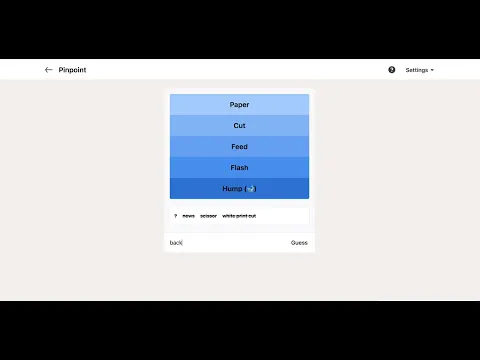
Stuck on LinkedIn Pinpoint 760? What connects Paper, Cut, Feed, Flash, and Hump (🐋)—and why? We've got you covered! This tricky linguistic trap is a perfect test of your semantic logic. Try our interactive hints first, then reveal the 30s expert logic and answer below to save your streak!
LinkedIn Pinpoint 760 Clues & Answer
💡 Hover (desktop) or tap (mobile) each clue to see how it connects to the answer
#1
Combines to form "Paperback," a common book binding format.
#2
Combines to form "Cutback," meaning a reduction in spending or output.
#3
Combines to form "Feedback," a response, critique, or audio loop.
#4
Combines to form "Flashback," a narrative device looking into the past.
#5
Combines to form "Humpback," a widely recognized species of baleen whale.
Answer: Words that come before “back”!
LinkedIn Pinpoint #760 Expert Logic
🧠 Expert Logic Walkthrough
When I first opened up today's grid and saw Paper, my mind immediately jumped to office supplies, origami, or maybe types of trees. It's a broad starting point, so I needed more context.
Then the second clue, Cut, dropped in. Oh, boy. The immediate pairing here is obvious: "paper cut." I spent a good minute wondering if the category was "Things that hurt" or "Things you do with scissors." It felt like a solid lead, but usually, Pinpoint doesn't give away the game that easily in the first two slots.
The turning point was Feed. Let's be honest, you don't "feed" a paper cut. I briefly entertained the idea of a printer theme—you feed paper into a printer, and some have automatic cutters. But that felt incredibly niche and clunky. Instead of looking at the physical objects, I shifted to wordplay. What happens if I attach a word to the end of these? Paper-[blank], Cut-[blank], Feed-[blank].
That's where it clicked. Paperback. Cutback. Feedback!
I rushed to the fourth clue, Flash, to test the theory. Flashback. Perfect. The pattern was locked in. By the time the final clue, Hump (🐋), was revealed, it was just a victory lap. The whale emoji was a cheeky little nudge specifically pointing to the Humpback whale, leaving zero doubt about the shared suffix.
Experience & Summary: This puzzle is a masterclass in the "Red Herring Pair." The creators knew exactly what they were doing by placing "Paper" and "Cut" back-to-back to force your brain into a specific phrase. To conquer these lateral thinking challenges, you have to be willing to abandon your initial physical associations the moment a third word refuses to fit the mold.
🎯 Category: Pinpoint 760
Words that come before “back”!
🔍 Semantic Analysis: Paper, Cut & More
| Clue | Logical Role | Why it fits |
|---|---|---|
| Paper | Prefix | Combines to form "Paperback," a common book binding format. |
| Cut | Prefix | Combines to form "Cutback," meaning a reduction in spending or output. |
| Feed | Prefix | Combines to form "Feedback," a response, critique, or audio loop. |
| Flash | Prefix | Combines to form "Flashback," a narrative device looking into the past. |
| Hump (🐋) | Prefix | Combines to form "Humpback," a widely recognized species of baleen whale. |
📊 Difficulty Rating
3.2 / 5.0
The difficulty here relies almost entirely on the initial "paper cut" red herring. It's incredibly easy to get trapped trying to find a category related to office supplies or sharp objects. However, once you pivot to viewing the clues as linguistic building blocks rather than physical concepts, the "Blank Filler" pattern unravels quite smoothly.
📜 Historical Pattern
Today’s logic relies heavily on The Blank Filler pattern. This is a Pinpoint staple where the clues have no physical or thematic relationship to one another, but rather share a common prefix or suffix to form compound words or familiar phrases.
Similar Pinpoint Examples:
- Pinpoint #460: Head, Dead, Bottom, Finish, Punch → Words that come before 'line'
- Pinpoint #519: Dust, Fur, Foot, Basket, Bowling → Words that come before 'ball'
- Pinpoint #527: Brain, Barn, Sand, Hail, Thunder → Words that come before 'storm'
👉 Learn more about “The Blank Filler” pattern.
💡 Lessons Learned From Pinpoint 760
- Beware the immediate pair: "Paper" and "Cut" naturally form a phrase together, which can derail your train of thought into a dead end. Always evaluate clues independently first.
- Shift from physical to structural: When "Feed" broke the office-supply theme, it was the perfect signal to stop looking for physical similarities and start looking for linguistic connections (like prefixes or suffixes).
- Emojis are literal hints: The whale emoji next to "Hump" wasn't just decorative; it was a dead giveaway that we were talking about marine life, specifically nudging the brain toward "Humpback."
🌟 Trivia
Did you know that male Humpback whales sing complex, evolving songs that can last up to 20 minutes? The term "humpback" itself comes from the way they dramatically arch their backs when preparing for a deep dive, making the fleshy hump highly visible before they disappear beneath the waves.
🔥 Hot News
Recent economic headlines are full of corporate cutbacks, particularly in the tech and media sectors, as companies streamline their operations. While a financial cutback is stressful in the real world, recognizing the term was the perfect linguistic bridge to solve today's "words before back" puzzle!
🎬 30s Logic Breakdown
Rapid Recap: Watch our focused logic video below to see the connection in action. We start with the everyday material concept of "Paper," bridge it to "Cut" via the common suffix "back," and then validate it through the diverse worlds of audio equipment (Feed), cinematic storytelling (Flash), and marine biology (Hump). It's a perfect example of how relying on linguistic structures can break you out of early semantic traps.
👉 Watch the pinpoint 760 video walkthrough.
❓ FAQ
Why is there a whale emoji next to "Hump"?
The whale emoji is a contextual clue to prevent ambiguity. It directs the player to think specifically about the "Humpback whale" rather than a camel or a geographic hill.
What does "feedback" mean in this context?
In this puzzle, "feed" is just a prefix. When combined with the answer, it creates "feedback," which can refer to critical evaluations, survey responses, or that awful screeching sound a microphone makes near a speaker.
Are "paper" and "cut" meant to trick the player?
Absolutely! Pinpoint creators love placing words sequentially that form a well-known phrase (like "paper cut") to act as a red herring, forcing you to rethink your logic when the third clue drops.
How do I get better at "Blank Filler" puzzles?
When thematic associations fail, immediately start testing common suffixes (like -man, -box, -back) or prefixes (like air-, fire-, water-) against the clues. Speaking the words aloud can also help trigger auditory memory for compound words.
Watch the logic walkthrough