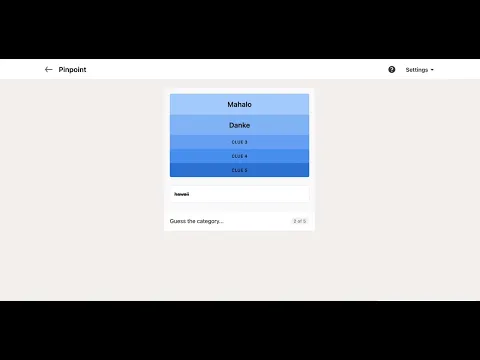
LinkedIn Pinpoint #693 Answer & Analysis
Stuck on LinkedIn Pinpoint 693? What connects Mahalo, Danke, Arigato, Merci, and Gracias—and why? We've got you covered! This satisfying word-pattern is a perfect test of your vocabulary depth. Try our interactive hints first, then reveal the 30s expert logic and answer below to save your streak!
LinkedIn Pinpoint 693 Clues & Answer
💡 Hover (desktop) or tap (mobile) each clue to see how it connects to the answer
#1
The standard expression of gratitude in the Hawaiian language.
#2
The standard expression of gratitude in German-speaking regions.
#3
A common, polite way to express thanks in Japanese.
#4
The primary word used to show appreciation in Francophone cultures.
#5
The universally recognized term for giving thanks in the Spanish-speaking world.
Answer: “Thank you” in different languages!
LinkedIn Pinpoint #693 Expert Logic
🧠 Expert Logic Walkthrough
When I first opened today's puzzle and saw Mahalo, my mind instantly drifted to a sunny Hawaiian beach. My initial thought was that we might be building a list of island-related terms, surfing jargon, or perhaps specific regional greetings like "Aloha."
But then Danke dropped onto the board. Well, there goes the tropical island theory! Jumping straight from the Pacific Ocean to Germany meant we weren't dealing with geography anymore. I had to look at what these two completely different words actually do. Both are the most common ways to express gratitude in their respective cultures.
To test this working theory, I revealed the third clue: Arigato. Bingo. Taking us straight to Japan, this confirmed we were looking at a universal human expression translated across different tongues. The pattern was locked in.
Clicking through to Merci (French) and Gracias (Spanish) was just the victory lap. It’s always incredibly satisfying when the puzzle makers step away from tricky wordplay and instead test our global vocabulary. No sneaky prefixes or hidden idioms here—just a pure, wholesome connection of worldwide appreciation!
Experience & Summary: When the game throws geographically disconnected foreign words at you, immediately stop looking for a physical link and start looking for a semantic one. Puzzles like this rely on your basic linguistic knowledge, asking you to translate the clues back into English to find their shared meaning.
🎯 Category: Pinpoint 693
“Thank you” in different languages!
🔍 Semantic Analysis: Mahalo, Danke & More
| Clue | Logical Role | Why it fits |
|---|---|---|
| Mahalo | Hawaiian Translation | The standard expression of gratitude in the Hawaiian language. |
| Danke | German Translation | The standard expression of gratitude in German-speaking regions. |
| Arigato | Japanese Translation | A common, polite way to express thanks in Japanese. |
| Merci | French Translation | The primary word used to show appreciation in Francophone cultures. |
| Gracias | Spanish Translation | The universally recognized term for giving thanks in the Spanish-speaking world. |
📊 Difficulty Rating
1.5 / 5.0
This is definitely on the breezier side of the Pinpoint spectrum! Most English speakers encounter these five specific translations constantly in pop culture, travel, and daily life. There are no deceptive red herrings here—just five highly recognizable words that all point directly to the same polite phrase.
📜 Historical Pattern
We’ve seen this exact type of cross-cultural linguistic connection before! Today's puzzle perfectly embodies the Synonym Cluster pattern, specifically leveraging foreign translations of a single English concept.
Similar Pinpoint Examples:
- Pinpoint #581: Due, Ni, Zwei, Dos, Deux → The number 'two' in different languages
- Pinpoint #531: Mint, Green, Novel, Fresh, Unused → Synonyms for 'new'
- Pinpoint #629: And, Or, But, Yet, So → Coordinating conjunctions
👉 Learn more about “Synonym Cluster” pattern.
💡 Lessons Learned From Pinpoint 693
- Look for universal meanings: When clues seem entirely disconnected by origin, translate them. They often share a single, underlying English definition.
- Don't overcomplicate geography: Jumping from Hawaii to Germany to Japan is a massive hint that the physical location doesn't matter; the linguistic function does.
- Cross-cultural synonyms are a staple: LinkedIn loves throwing in basic foreign vocabulary sets. If you see numbers, greetings, or pleasantries in other languages, assume a translation theme immediately.
🌟 Trivia
Did you know that Mahalo means much more than just a simple "Thank you"? In native Hawaiian culture, the word translates more deeply to "in the presence of the divine breath." It’s an expression of deep spiritual respect and gratitude, making it a profoundly meaningful way to show appreciation!
🔥 Hot News
With global tourism to Japan surging to record-breaking highs this year, travelers are brushing up on essential phrases more than ever. Knowing how to politely drop an Arigato at a local Tokyo cafe or a Gracias in a bustling Madrid market isn't just good manners—it's become a major trend on language-learning apps as people prioritize authentic cultural connections over simple sightseeing. Understanding how to say "Thank you" is truly the ultimate passport!
🎬 30s Logic Breakdown
Rapid Recap: Watch our focused logic video below to see the connection in action. We start with the Hawaiian linguistic concept of "Mahalo," bridge it to "Danke" via the translation theme "Thank you," and then validate it through the diverse worlds of Japanese, French, and Spanish. It's a perfect example of how basic human gratitude transcends borders.
👉 Watch the pinpoint 693 video walkthrough.
❓ FAQ
What language is Mahalo?
It is Hawaiian, widely used across the Hawaiian islands to express gratitude and respect.
Is Arigato formal or informal?
On its own, it is somewhat informal. For more polite or formal situations in Japan, "Arigato gozaimasu" is the preferred phrasing.
Are there other common ways to say "Thank you" that could have been used here?
Absolutely! The puzzle easily could have featured "Grazie" (Italian), "Obrigado" (Portuguese), or "Spasibo" (Russian).
Why wasn't an English word included in the clues?
Including "Thanks" or "Appreciation" alongside these foreign words would have broken the aesthetic of the puzzle and made the shared translation answer a bit too obvious right out of the gate!
Watch the logic walkthrough