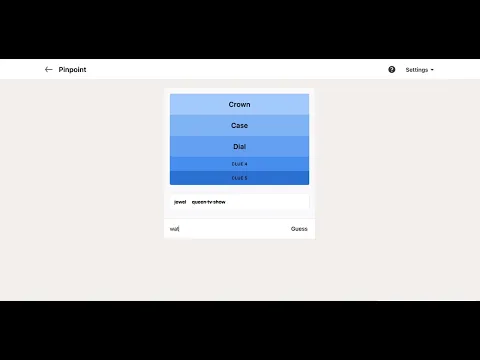
LinkedIn Pinpoint #732 Answer & Analysis
Stuck on LinkedIn Pinpoint 732? What connects Crown, Case, Dial, Strap, and Hands (of different lengths)—and why? We've got you covered! This elite-level association is a perfect test of your lateral thinking. Try our interactive hints first, then reveal the 30s expert logic and answer below to save your streak!
LinkedIn Pinpoint 732 Clues & Answer
💡 Hover (desktop) or tap (mobile) each clue to see how it connects to the answer
#1
The small grooved knob used to wind a watch or set the time.
#2
The protective metal or plastic housing that contains the inner workings.
#3
The face of the watch where the numbers or indices are arranged.
#4
The band (leather, metal, or nylon) that secures the device to your wrist.
#5
The pointing devices (hour, minute, second) that rotate to show the time.
Answer: Parts of a wristwatch!
LinkedIn Pinpoint #732 Expert Logic
🧠 Expert Logic Walkthrough
When you first see Crown, what is the immediate reaction? My brain instantly goes to royalty, tiaras, or maybe that terrifying trip to the dentist I've been putting off. It’s a word with very strong, distinct definitions, so I knew I had to keep an open mind.
Then came Case. Talk about a pivot. Are we looking at legal terminology now? Or maybe luggage? Trying to link a royal headpiece to a suitcase didn't feel right. Perhaps a display case for the crown jewels? That felt plausible but a little too loose for a Pinpoint puzzle.
Bringing in Dial changed the landscape entirely. Now we're turning knobs. A telephone? A radio? But wait... if I look at it this way, you turn a crown on certain devices, too. That’s where it clicked. I looked down at my own wrist. A watch has a dial to show the time, a protective outer case, and a little grooved knob on the side—the crown—to set it.
Now we’re getting somewhere, and the final clues just locked the door behind us. A Strap keeps it secured to your wrist, and the Hands (of different lengths) spin around to tell the hours and minutes. The satisfaction of seeing these completely disparate words snap together into a single, everyday object is exactly why I love this game.
Experience & Summary: This puzzle is a masterclass in recontextualizing vocabulary. Words like "crown" and "case" have such dominant primary meanings that our brains naturally overlook their secondary, mechanical definitions. The trick to beating these "parts of a whole" puzzles is to imagine shrinking yourself down and walking around the words as physical objects until you find the machine they all belong to.
🎯 Category: Pinpoint 732
Parts of a wristwatch!
🔍 Semantic Analysis: Crown, Case & More
| Clue | Logical Role | Why it fits |
|---|---|---|
| Crown | The mechanism | The small grooved knob used to wind a watch or set the time. |
| Case | The housing | The protective metal or plastic housing that contains the inner workings. |
| Dial | The display | The face of the watch where the numbers or indices are arranged. |
| Strap | The anchor | The band (leather, metal, or nylon) that secures the device to your wrist. |
| Hands (of different lengths) | The indicators | The pointing devices (hour, minute, second) that rotate to show the time. |
📊 Difficulty Rating
3.2 / 5.0
This puzzle starts off highly deceptive. "Crown" and "Case" act as massive red herrings, pulling your thoughts toward royalty, dentistry, law, or luggage. It isn't until "Dial" drops that the mechanical and horological theme begins to take shape. It’s a solid mid-level challenge that rewards patience and a broad vocabulary.
📜 Historical Pattern
We love a good structural breakdown, and today’s puzzle falls perfectly into the Parts of a Whole category. This pattern challenges players by listing specific components of a single overarching object or location.
Similar Pinpoint Examples:
- Pinpoint #486: Temple, Bridge, Hinge, Nose pad, Lenses → Parts of eyeglasses/spectacles
- Pinpoint #656: Tailfin, Gondola, Propeller, Ballonets (inflatable bags), Helium gas envelope → Parts of a blimp
- Pinpoint #728: Radio, Vent, Speedometer, Airbag, Check engine light → Parts of a car dashboard
👉 Learn more about “Parts of a Whole” pattern.
💡 Lessons Learned From Pinpoint 732
- Beware the Dominant Definition: Words like "crown" naturally trigger thoughts of kings and queens. Always pause to consider a word's secondary or mechanical meaning.
- Look for the Physical Assembly: If the clues are all tangible nouns, try visualizing them in 3D space to see if they attach to one another.
- Let the Modifiers Guide You: The parenthetical "(of different lengths)" in the final clue is the ultimate giveaway, directly distinguishing watch hands from human ones. Pay close attention to extra descriptive text!
🌟 Trivia
Did you know the Hands of a watch didn't always come in pairs? Early pocket watches and clocks only had an hour hand! It wasn't until the late 17th century, when the internal mechanisms (inside the Case) became significantly more accurate, that the minute hand was widely introduced. Even today, the varying lengths of the hands are a brilliant piece of functional design, allowing you to read the Dial at a mere glance without confusing hours for minutes.
🔥 Hot News
The luxury wristwatch market has recently seen an unexpected surge in interest among Gen Z buyers, with vintage models featuring unique Dial designs fetching massive prices at auction. Interestingly, many smartwatches are now releasing digital faces that mimic the mechanical sweep of traditional Hands, proving that the classic aesthetic of a winding Crown and a leather Strap remains timeless, even in the digital age.
🎬 30s Logic Breakdown
Rapid Recap: Watch our focused logic video below to see the connection in action. We start with the deceptive concept of "Crown," bridge it to "Case" via the mechanical theme "Parts of a wristwatch!," and then validate it through the diverse worlds of horology, daily accessories, and timekeeping. It's a perfect example of how an assembly of standalone nouns can perfectly construct a singular, recognizable object.
👉 Watch the pinpoint 732 video walkthrough.
❓ FAQ
Why is the knob on a watch called a Crown?
It historically earned the name because the winding knobs on early pocket watches were heavily fluted and decorated, closely resembling royal crowns.
Are watch Hands always different lengths?
Yes, the hour hand is traditionally shorter and thicker, while the minute hand is longer, reaching closer to the edge of the Dial to easily distinguish between the two at a glance.
What is the difference between a watch Strap and a bracelet?
In watch terminology, a "Strap" usually refers to bands made of flexible materials like leather, rubber, or nylon, whereas a "bracelet" refers to a band made of linked metal.
Is the Dial the same thing as the watch face?
Yes, "Dial" is the traditional horological term for the face of the watch, which sits inside the Case and displays the time indices.
Watch the logic walkthrough