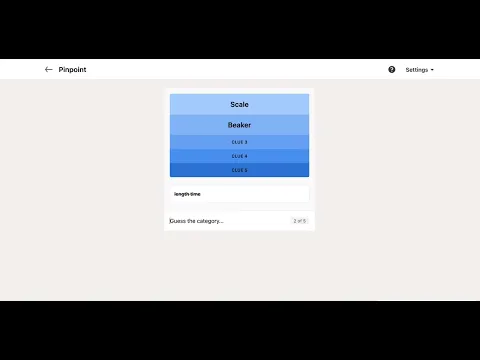
LinkedIn Pinpoint #742 Answer & Analysis
Stuck on LinkedIn Pinpoint 742? What connects Scale, Beaker, pH meter, Test tube, and Bunsen burner—and why? We've got you covered! This clean object category is a perfect test of your pattern recognition. Try our interactive hints first, then reveal the 30s expert logic and answer below to save your streak!
LinkedIn Pinpoint 742 Clues & Answer
💡 Hover (desktop) or tap (mobile) each clue to see how it connects to the answer
#1
A broad-meaning word whose scientific context is defined by the next clue.
#2
Immediately establishes the "laboratory" theme and clarifies the meaning of "Scale."
#3
Narrows the theme from a general lab to a chemistry-focused one.
#4
A universally recognized symbol of a chemistry lab, adding strong visual confirmation.
#5
Another iconic piece of equipment that leaves no doubt about the category.
Answer: Things found in a chemistry laboratory!
LinkedIn Pinpoint #742 Expert Logic
🧠 Expert Logic Walkthrough
When Scale popped up as the first clue, my mind immediately sorted through the possibilities. Are we talking musical scales? The scales on a fish? Or a device for measuring weight? Given Pinpoint's love for concrete categories, the weighing instrument felt like the strongest starting point.
Then came Beaker. And just like that, the other definitions of "scale" evaporated. You don't find a musical scale next to a beaker. This pairing immediately conjured an image of a science classroom or a laboratory. The mental model shifted from "things that measure" to a much more specific "tools for science."
The third clue, pH meter, was the moment the entire puzzle snapped into focus. It's not just a generic scientific instrument; it's a piece of equipment specifically for chemical analysis. My hypothesis instantly narrowed from "science lab" to the more precise "chemistry lab."
Seeing Test tube and Bunsen burner next was pure confirmation. These are the rockstars of chemistry equipment, the two items anyone would draw if asked to sketch a laboratory. The pattern was undeniable, with each clue reinforcing the others perfectly. It was a satisfying, straightforward solve that relied on recognizing a classic thematic set.
Experience & Summary
This puzzle is a great example of the "funnel" approach. The first clue is often broad, but each subsequent clue acts as a filter, narrowing the possibilities until only one logical answer remains. The key was using the second clue, Beaker, to correctly define the context for Scale and then letting the more specific clues like pH meter seal the deal.
🎯 Category: Pinpoint 742
Things found in a chemistry laboratory!
🔍 Semantic Analysis: Scale, Beaker & More
| Clue | Logical Role | Why it fits |
|---|---|---|
| Scale | The Opener | A broad-meaning word whose scientific context is defined by the next clue. |
| Beaker | The Context Setter | Immediately establishes the "laboratory" theme and clarifies the meaning of "Scale." |
| pH meter | The Specific Validator | Narrows the theme from a general lab to a chemistry-focused one. |
| Test tube | The Iconic Example | A universally recognized symbol of a chemistry lab, adding strong visual confirmation. |
| Bunsen burner | The Thematic Clincher | Another iconic piece of equipment that leaves no doubt about the category. |
📊 Difficulty Rating
1.5 / 5.0
This was a very accessible puzzle. The only potential hiccup was the initial ambiguity of the word Scale, but the subsequent clues were so direct and thematically consistent that they quickly eliminated any confusion. There were no real "red herring" clues, making this a fairly gentle warm-up.
📜 Historical Pattern
Today's puzzle falls squarely into the Location-Based pattern, where all clues are items or concepts associated with a specific place. It’s less about wordplay and more about recognizing a shared environment.
Similar Pinpoint Examples:
- Pinpoint #687: Fog, Cable cars, Ghirardelli Square... → Things associated with San Francisco!
- Pinpoint #561: The Underground, Double-decker buses, The Thames... → Things associated with London
- Pinpoint #495: Bandage, Scale, Stethoscope... → Things at a doctor’s office
👉 Learn more about “Location-Based” pattern.
💡 Lessons Learned From Pinpoint 742
- Context is King: The first clue might be a riddle, but the second clue is often the key that unlocks its true meaning within the puzzle's context.
- Specificity Wins: When you get a highly specific clue like pH meter, trust it. It's designed to be the anchor that grounds your theory.
- Don't Overthink the Obvious: When all clues point to a classic, well-known category, the answer is usually exactly what it looks like. There's no hidden trick here.
- Build a Mental Image: Visualizing the clues together in one place—a lab bench in this case—is a powerful strategy for solving location-based puzzles.
🌟 Trivia
While the Bunsen burner is named after Robert Bunsen, he didn't actually invent it! He improved upon an existing design, but the prototype was created by his talented laboratory assistant, Peter Desaga, in 1855. Bunsen's contribution was making it a safe, efficient, and popular tool for labs worldwide.
🔥 Hot News
The very tools in this puzzle are being revolutionized. A recent trend in scientific research is the rise of AI-driven, "self-driving" laboratories. These advanced labs use robotics and machine learning to automate experiments, allowing a pH meter to take readings, a robotic arm to handle a beaker, and data to be analyzed without constant human supervision. This puzzle's chemistry laboratory theme is at the forefront of a major technological leap, accelerating discoveries in medicine and materials science.
🎬 30s Logic Breakdown
Rapid Recap: Watch our focused logic video below to see the connection in action. We start with the ambiguous measurement concept of "Scale," bridge it to "Beaker" via the thematic "laboratory," and then validate it through the diverse worlds of measurement, containment, and heating. It's a perfect example of how recognizing a shared environment locks in the answer.
👉 Watch the pinpoint 742 video walkthrough.
❓ FAQ
Could the answer just be 'science equipment'?
Yes, that's a valid category, but "Things found in a chemistry laboratory!" is more precise. Clues like the Bunsen burner and pH meter are particularly characteristic of chemistry, making it the stronger, more specific solution.
What is the primary difference between a beaker and a test tube?
A beaker is a wide, cylindrical container with a flat bottom and a lip for pouring, designed for mixing, stirring, and heating larger liquid volumes. A test tube is a small, thin glass tube with a U-shaped bottom, used for holding and observing small-scale chemical reactions.
Is a Bunsen burner still widely used in modern labs?
Absolutely. While many labs now use precise electric heating mantles or hot plates, the Bunsen burner remains a staple for simple, high-temperature heating, sterilizing equipment, and in educational settings due to its simplicity and effectiveness.
Why is a pH meter important in chemistry?
A pH meter is crucial because it provides a precise measurement of a solution's acidity or alkalinity. This is fundamental in countless applications, from manufacturing and environmental testing to medical diagnostics and food science, where exact pH levels can determine the outcome of a reaction or the safety of a product.
Watch the logic walkthrough