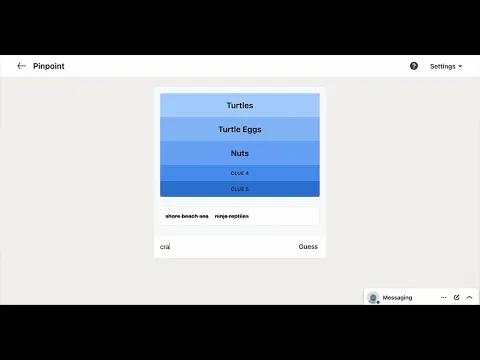
LinkedIn Pinpoint #462 Answer & Analysis
Looking for the Pinpoint #462 answer? Beyond Turtles, Turtle Eggs, Nuts, Coconuts, and Clams, the logic is trickier than you think. It's not about just food items from nature! Get our fast answer and expert logic tips below to save your streak now.
LinkedIn Pinpoint 462 Clues & Answer
💡 Hover (desktop) or tap (mobile) each clue to see how it connects to the answer
#1
The most recognizable "shelled" animal; sets the structural theme.
#2
Shifts the logic from the animal's body to its reproductive process.
#3
Moves the logic into the pantry, testing if the player can identify "shells" in food.
#4
A large-scale botanical example that mimics the toughness of an animal shell.
#5
Uses the "if not on stands" qualifier to ensure the player focuses on the physical shell, not the shucked meat.
Answer: Things with shells
LinkedIn Pinpoint #462 Expert Logic
1. Introduction
LinkedIn Pinpoint #462 is a masterclass in evolutionary and structural commonality. At first glance, the clues span the kingdoms of biology and botany, ranging from marine life to snacks found in a pantry. However, the puzzle asks the player to look past the "life form" and focus on the "architecture." The unifying theme is a protective, hardened exterior designed by nature to safeguard the life or nutrients within.
2. How the Puzzle Came Together
The logic of this puzzle is built on the concept of Evolutionary Armor. It begins with the Turtles, perhaps the most iconic example of a vertebrate using a permanent, bony housing for survival. This biological theme is reinforced by Clams (if not on stands); while one is a reptile and the other a mollusk, they both rely on calcium-based structures for defense. The parenthetical "if not on stands" is a clever linguistic pivot, likely referring to "clam stands" (roadside eateries) where the shells are removed for consumption, thus forcing the player to think of the organism in its natural, "shelled" state.
The puzzle then shifts from the animal kingdom to the botanical world. The inclusion of Nuts and Coconuts broadens the scope. While we often think of these as food, the puzzle highlights their physical reality: they are seeds protected by lignified walls. Finally, the mention of Turtle Eggs acts as the "connective tissue." It links the reptile (Turtles) to a different type of shell—one that is temporary and developmental rather than permanent. This transition from bone to wood to calcium carbonate demonstrates the depth of the "shell" category.
3. Category: Pinpoint 462
- A. Core Answer: Things with shells
- B. Difficulty Rating: 2.5 / 5.0 (The clues are diverse, but the concept of a "shell" is a very strong primary association for each individual item).
4. Words & How They Fit
Semantic Logic Breakdown
- Protective Barriers: Every item on the list features a hard outer layer that must be cracked, peeled, or shucked to reach the interior.
- Cross-Domain Consistency: The puzzle successfully bridges Zoology (Turtles, Clams), Botany (Nuts, Coconuts), and Developmental Biology (Eggs).
Logic Role Classification
| Clue | Logical Role | Why it fits |
|---|---|---|
| Turtles | The Prototype | The most recognizable "shelled" animal; sets the structural theme. |
| Turtle Eggs | The Derivative | Shifts the logic from the animal's body to its reproductive process. |
| Nuts | The Culinary Shift | Moves the logic into the pantry, testing if the player can identify "shells" in food. |
| Coconuts | The Scale Variant | A large-scale botanical example that mimics the toughness of an animal shell. |
| Clams | The Contextual Pivot | Uses the "if not on stands" qualifier to ensure the player focuses on the physical shell, not the shucked meat. |
5. Better Analysis Directions
A. Red Herring Analysis (The "Beach" Trap)
A common mistake in #462 is gravitating toward a "Tropical/Ocean" theme. Turtles, Clams, Coconuts, and even Turtle Eggs are all found on or near beaches. However, Nuts (like walnuts or pecans) completely break this geographical link. The "Expert" player recognizes that when one clue doesn't fit the "vibe," they must pivot to a physical "attribute."
B. Historical Pattern (Physical Anatomy)
Pinpoint frequently utilizes puzzles based on Anatomical Features (e.g., Things with wings, Things with tails). #462 follows this high-frequency pattern. Historically, these puzzles are solved by identifying the "odd one out" (in this case, the Nuts) and finding the physical trait it shares with the more obvious biological examples.
C. The Expert Workflow
- Initial Scan: Identify the hard exterior of Turtles and Clams.
- Pattern Extension: See if Nuts and Coconuts share a "hard exterior." They do—the shell.
- Refinement: Check the qualifier. "If not on stands" for Clams implies that at a "stand," the shell is gone. This confirms the "Shell" is the focal point.
- Final Verification: Does a Turtle Egg have a shell? Yes. The logic holds across all 5 points.
6. Lessons Learned From Pinpoint 462
This puzzle teaches us the importance of Categorical Breadth. When solving Pinpoint, don't get locked into a single kingdom (like "Animals"). Nature often uses the same engineering solutions (like a hard shell) across vastly different species and plants. Also, pay attention to qualifiers—they are designed to strip away secondary meanings and leave you with the literal, physical truth.
💡 Trivia: The Unbreakable Bond of the Turtle Shell
Unlike the "shells" of Clams or the Nuts we eat, a Turtle's shell is actually a permanent part of its skeleton. It is made of about 50 bones, including the turtle's ribcage and spine, which are fused together.
This means a turtle cannot "crawl out" of its shell like a cartoon character! The shell grows with the turtle throughout its life, and because it contains nerves and blood vessels, a turtle can actually feel it if you touch or scratch its shell. It’s not just a house; it’s a living, sensing part of their body.
FAQ
Q: Why was the "if not on stands" qualifier used for Clams? A: In North American English, a "Clam Stand" is a popular type of roadside restaurant that serves fried clams. At these stands, the clams are almost always served "shucked" (without the shell). The qualifier ensures the player thinks of the clam in the wild, where the shell is its defining feature.
Q: Are all "Nuts" technically shells? A: Botanically, a "nut" is defined as a dry fruit with a single seed and a hard shell. While some things we call nuts (like peanuts) are technically legumes, they still possess a "shell" in common parlance, which is what Pinpoint relies on.
Watch the logic walkthrough