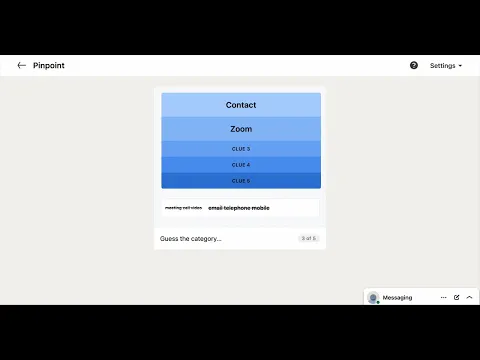
LinkedIn Pinpoint #464 Answer & Analysis
Looking for the Pinpoint #464 answer? Beyond Contact, Zoom, Fish-eye, Telephoto, and Bifocal, the logic is trickier than you think. It's not about digital communication platforms! Get our fast answer and expert logic tips below to save your streak now.
LinkedIn Pinpoint 464 Clues & Answer
💡 Hover (desktop) or tap (mobile) each clue to see how it connects to the answer
#1
A corrective, cosmetic, or therapeutic lens placed directly on the surface of the eye.
#2
A lens with a mechanical assembly that allows for varying focal lengths.
#3
An ultra-wide-angle lens that produces strong visual distortion intended to create a wide panoramic or hemispherical image.
#4
A specific type of long-focus lens in which the physical length of the lens is shorter than the focal length.
#5
A lens with two distinct optical powers, typically used for people with presbyopia. The "not on stands" hint ensures you think of the glass itself.
Answer: Lenses
LinkedIn Pinpoint #464 Expert Logic
1. Introduction
LinkedIn Pinpoint #464 is a masterclass in optical convergence. This puzzle challenges players to find the common thread between the world of professional photography and the field of optometry. While the clues range from high-tech camera equipment to everyday vision correction, they all rely on the same fundamental physics of light refraction and curved glass (or plastic).
2. How the Puzzle Came Together
The puzzle construction utilizes a clever "industry split." It begins with Zoom, Fish-eye, and Telephoto—terms deeply embedded in the vocabulary of photographers and cinematographers. These three clues establish a strong "Camera Equipment" theme.
However, the logic takes a medical turn with Contact and Bifocal. By introducing vision correction, the puzzle forces the player to look past the "device" (the camera or the glasses) and focus on the "component" that makes them work. The qualifier (if not on stands) attached to the final clues serves as the logical guardrail; it distinguishes the raw optical element from stationary laboratory equipment or mounted telescopes, steering the player toward the singular, portable object: the lens.
3. Category: Pinpoint 464
- A. Core Answer: Lenses
- B. Difficulty Rating: 1.8 / 5.0 (The photography clues are highly recognizable, making the "Aha!" moment relatively quick for most players).
4. Words & How They Fit
Semantic Logic Breakdown
- Focal Manipulation: Every clue describes a specific way light is bent to change the viewer's perspective or clarity.
- Optical Engineering: These are specific classifications of optical components based on their curvature and purpose.
Logic Role Classification
| Clue | Logical Role | Why it fits |
|---|---|---|
| Zoom | The Variable | A lens with a mechanical assembly that allows for varying focal lengths. |
| Fish-eye | The Stylist | An ultra-wide-angle lens that produces strong visual distortion intended to create a wide panoramic or hemispherical image. |
| Telephoto | The Distance | A specific type of long-focus lens in which the physical length of the lens is shorter than the focal length. |
| Contact | The Biological | A corrective, cosmetic, or therapeutic lens placed directly on the surface of the eye. |
| Bifocal | The Precision Anchor | A lens with two distinct optical powers, typically used for people with presbyopia. The "not on stands" hint ensures you think of the glass itself. |
5. Better Analysis Directions
A. Red Herring Analysis (The "Camera" Trap)
The most common pitfall in #464 is identifying the category as "Camera Parts." While Zoom, Fish-eye, and Telephoto are synonymous with photography, Contact and Bifocal do not fit a camera. The "Expert" solver recognizes that "Camera" is too narrow and "Glass" is too broad. "Lenses" is the "Goldilocks" answer—perfectly specific to the function of all five items.
B. Historical Pattern (Functional Components)
Pinpoint often features puzzles where the clues are "Sub-components of different machines." For example, a puzzle might list "Hard Drive, RAM, Processor, Motherboard." #464 follows this pattern by listing components that exist across different "machines" (Eyes, Cameras, Projectors).
C. The Expert Workflow
- Pattern Recognition: Group Zoom, Fish-eye, and Telephoto under "Photography."
- Constraint Testing: Try to fit Contact into "Photography." It fails.
- The Pivot: Shift the category from "Photography" to "Optics."
- Verification: Does "Bifocal" fit under "Optics"? Yes. Is a "Zoom" a lens? Yes.
- Final Polish: The answer is the plural "Lenses" to account for the variety.
6. Lessons Learned From Pinpoint 464
This puzzle teaches us to look for the "Engine" of the object. When you see a list of tools or devices, ask yourself: What is the one part inside all of these that actually does the work? In this case, the camera and the glasses are just the "housing"; the Lens is the part performing the function.
💡 Trivia: The "Delicious" Origin of the Lens
The word "Lens" actually comes from the Latin word for "Lentil" (Lens culinaris).
Why? Because early glass-polishers in the 13th century noticed that the double-convex shapes they were creating to help people see better looked exactly like the small, brown legumes found in their soup! If you look at a lentil from the side, it has the exact same curvature as a standard magnifying Bifocal lens.
FAQ
Q: Why was "if not on stands" included? A: This qualifier is likely used to prevent players from guessing "Telescopes" or "Microscopes," which are often defined by their mounting/stands. It forces the mind to focus on the glass element itself.
Q: Is a "Zoom" a type of lens or a function? A: In this context, it is a type of lens (a "Zoom Lens"). Unlike a "Prime Lens" which has a fixed focal length, a Zoom lens is a physical object that contains moving elements to change magnification.
Watch the logic walkthrough