LinkedIn Pinpoint #475 Answer & Analysis
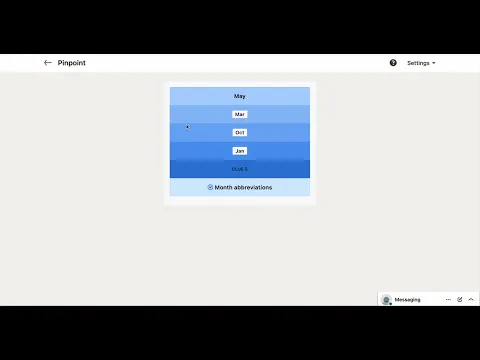
Looking for the Pinpoint #475 answer? Beyond May, Mar, Oct, Jan, and Dec, the logic is trickier than you think. It's not about a simple alphabetical sequence! Get our fast answer and expert logic tips below to save your streak now.
LinkedIn Pinpoint 475 Clues & Answer
💡 Hover (desktop) or tap (mobile) each clue to see how it connects to the answer
#1
Tests the player's ability to recognize a word that doesn't change when shortened.
#2
Confirms the "Consonant-Vowel-Consonant" or "Consonant-Vowel-Liquid" shortening.
#3
Moves the timeline to the end of the year, proving the rule applies across the whole calendar.
#4
Establishes the 3-letter sequence and the "Start of Year" theme.
#5
The "if not on stands" note distinguishes the text "Dec" from "Decorations" or "Decks."
Answer: Month abbreviations
LinkedIn Pinpoint #475 Expert Logic
1. Introduction
LinkedIn Pinpoint #475 is a masterclass in linguistic economy. At first glance, the clues appear to be a random assortment of calendar entries. However, the puzzle challenges the player to identify not just the category of "Time," but the specific typographic format used to represent it. By blending standard calendar months with a clever conditional qualifier, this puzzle tests your ability to recognize patterns in data shortening and professional shorthand.
2. How the Puzzle Came Together
The puzzle sequence begins with Jan, Mar, and Oct, which immediately establish a rhythmic, three-letter pattern. These are the "low-hanging fruit" that guide the player toward the Gregorian calendar. However, the inclusion of May adds a layer of complexity; because "May" is already three letters long, it functions as both the full name and its own shorthand, momentarily blurring the line between a "Month" and an "Abbreviation."
The logic is solidified by the final clue, Dec (if not on stands). This is the "logical pivot." While "Dec" is the standard shortening for December, the parenthetical hint prevents the player from wandering toward "Decorations" or "Decks" (as in a ship's deck or a deck of cards). By excluding the physical "stands" (which could imply newsstands or structural supports), the puzzle forces the "Dec" to remain in its purely textual, abbreviated form.
3. Category: Pinpoint 475
- A. Core Answer: Month abbreviations
- B. Difficulty Rating: 1.8 / 5.0 (The three-letter consistency makes the pattern highly visible early on).
4. Words & How They Fit
Semantic Logic Breakdown
- The Three-Letter Constraint: Every clue follows the industry-standard 3-character format (ISO 8601 style) used in computing, journalism, and scheduling.
- The Identity Exception: "May" serves as the control variable, being the only month where the abbreviation is identical to the full name.
Logic Role Classification
| Clue | Logical Role | Why it fits |
|---|---|---|
| Jan | The Opener | Establishes the 3-letter sequence and the "Start of Year" theme. |
| Mar | Pattern Reinforcer | Confirms the "Consonant-Vowel-Consonant" or "Consonant-Vowel-Liquid" shortening. |
| Oct | The Anchor | Moves the timeline to the end of the year, proving the rule applies across the whole calendar. |
| May | The "Hidden" Abbreviation | Tests the player's ability to recognize a word that doesn't change when shortened. |
| Dec | The Qualifier | The "if not on stands" note distinguishes the text "Dec" from "Decorations" or "Decks." |
5. Better Analysis Directions
A. Semantic Trap: The "Month" vs. "Abbreviation" Distinction
The primary "Red Herring" here is simply answering "Months." While technically true, Pinpoint rewards precision. Because months like "September" or "June" are missing, and every clue is exactly three letters, the logic specifically points to the shortened form. An expert player looks for the "Constraint" (3 letters) rather than just the "Theme" (Time).
B. Historical Pattern: Data Standards
Pinpoint often utilizes Standardized Lists (e.g., Periodic Table symbols, State abbreviations). #475 falls into this category. In professional environments—from Excel spreadsheets to financial tickers—these 3-letter codes are the universal language of temporal data.
C. The Expert Workflow
- Pattern Recognition: Notice that Jan, Mar, and Oct are all truncated versions of longer words.
- Constraint Testing: Observe that May is also three letters. This confirms the "3-letter rule" is the primary logic.
- Ambiguity Resolution: Read Dec (if not on stands). Realize that "Dec" could mean "Decoration" or "Deck," but the qualifier strips away those meanings, leaving only the month.
- Final Synthesis: Combine "Months" with the "3-letter" observation to reach "Month abbreviations."
6. Lessons Learned From Pinpoint 475
The takeaway from this puzzle is the importance of character counts. In word puzzles, if every clue shares the same length, that length is almost certainly part of the answer's definition. Additionally, #475 teaches us that a word can belong to a category of "shortened forms" even if it wasn't actually shortened (like "May").
💡 Trivia: The "May" Exception and the Unix Legacy
In the world of computer programming and global data standards (like ISO 8601), month abbreviations are almost always fixed at three characters to ensure database columns remain perfectly aligned.
Because May is the only month in the English language with only three letters, it is the "Perfect Month" for programmers. While Sept. or Sept can cause formatting errors in old codebases due to varying lengths (3 vs 4 letters), May never requires a period or a truncation. This makes it the only month that is "natively" compatible with both human reading and machine shorthand!
FAQ
Q: Why was "Dec (if not on stands)" used instead of just "Dec"? A: In casual English, "Dec" is frequently used as shorthand for "Decorations" (especially during the holidays). By adding "if not on stands," the puzzle creator clarifies that we are talking about the calendar month, not a physical object on a display stand.
Q: Are these abbreviations used globally? A: These specific 3-letter abbreviations are standard in English-speaking countries and are the default for most international software interfaces (the "C" or "POSIX" locale).
Q: Could "June" or "July" have been clues? A: Technically yes, but they are often abbreviated as "Jun" or "Jul." By choosing "Jan, Mar, Oct, Dec," the creator chose months that must be shortened to fit the 3-letter rule, making the logic clearer.
Watch the logic walkthrough