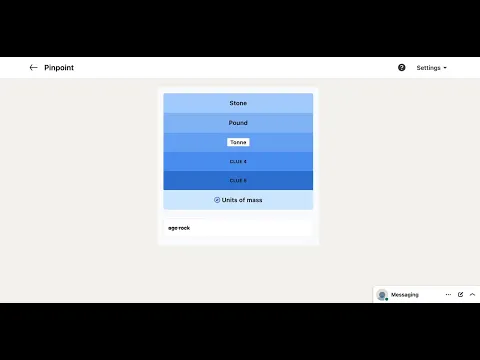
LinkedIn Pinpoint #546 Answer & Analysis
Looking for the Pinpoint #546 answer? Beyond Stone, Pound, Tonne, Gram, and Ounce, the logic is trickier than you think. It's not about types of currency! Get our fast answer and expert logic tips below to save your streak now.
LinkedIn Pinpoint 546 Clues & Answer
💡 Hover (desktop) or tap (mobile) each clue to see how it connects to the answer
#1
A specific unit (14 lbs) used primarily in the UK and Ireland for body weight.
#2
A common unit that also serves as a "Red Herring" for currency or verbs.
#3
Represents the metric "1,000 kg," establishing the category's scientific side.
#4
The base unit of mass in the metric system, providing a clear scientific anchor.
#5
A small unit used for everything from food to precious metals; the qualifier ensures it's viewed as a unit.
Answer: Units of mass
LinkedIn Pinpoint #546 Expert Logic
1. Introduction
LinkedIn Pinpoint #546 is a masterclass in standardized measurement. This puzzle challenges players to look past the physical objects these words might represent and focus instead on their roles as quantitative descriptors. By blending units from both the Imperial and Metric systems, the puzzle tests the player's ability to identify a shared functional purpose: the measurement of mass.
2. How the Puzzle Came Together
The puzzle construction begins with Stone and Pound, two clues that immediately evoke a British or traditional Imperial context. While "Stone" could easily refer to geology, its proximity to "Pound" narrows the scope to weight. The logical framework expands globally with the introduction of Tonne and Gram, shifting the focus from purely regional units to a universal scientific scale.
The final clue, Ounce (if not on stands), acts as the definitive boundary. While an "ounce" is a common unit, the qualifier "if not on stands" (a classic Pinpoint instructional nuance) ensures the player differentiates the abstract unit of measurement from any physical objects or measuring devices that might be displayed as decor. This logical progression forces the player to discard secondary meanings—like currency or construction materials—and settle on the physical property shared by all five: mass.
3. Category: Pinpoint 546
- A. Core Answer: Units of mass
- B. Difficulty Rating: 1.8 / 5.0 (The clues are highly synonymous within their field, making the connection relatively intuitive for most players).
4. Words & How They Fit
Semantic Logic Breakdown
- Scalar Versatility: The clues range from the microscopic (Gram) to the massive (Tonne), covering the entire spectrum of weight measurement.
- System Integration: The puzzle successfully bridges the gap between the International System of Units (SI) and the British Imperial system.
Logic Role Classification
| Clue | Logical Role | Why it fits |
|---|---|---|
| Stone | The Regional Hook | A specific unit (14 lbs) used primarily in the UK and Ireland for body weight. |
| Pound | The Linguistic Pivot | A common unit that also serves as a "Red Herring" for currency or verbs. |
| Tonne | The Macro Scale | Represents the metric "1,000 kg," establishing the category's scientific side. |
| Gram | The Micro Scale | The base unit of mass in the metric system, providing a clear scientific anchor. |
| Ounce | The Precision Qualifier | A small unit used for everything from food to precious metals; the qualifier ensures it's viewed as a unit. |
5. Better Analysis Directions
A. Red Herring Analysis (The "Geology & Currency" Trap)
Beginners often get stuck on the word Stone, thinking of "Types of Rock," or Pound, thinking of "Currencies." However, the inclusion of Gram—which has no meaning in currency or geology—immediately invalidates those paths. The expert player identifies that "Gram" is the most "pure" clue, as it has the fewest alternative meanings, and uses it to re-evaluate the other four.
B. Historical Pattern (The "Mixing Systems" Strategy)
Pinpoint puzzles frequently use Cross-System Categorization. By mixing Imperial (Ounce, Pound, Stone) with Metric (Gram, Tonne), the puzzle designer prevents the answer from being too specific (e.g., "Metric Units"). This forces the player to find a broader, more fundamental scientific term like "Mass" or "Weight."
C. The Expert Workflow
- Isolate the Anchor: Identify Gram and Tonne as strictly measurement-related.
- Test the Bridge: See if Pound and Ounce fit the measurement theme. (They do).
- Resolve the Outlier: Check if Stone fits. In the context of weight, a "Stone" is 14 pounds.
- Synthesize: All five are units used to quantify how much matter is in an object.
6. Lessons Learned From Pinpoint 546
This puzzle teaches us the importance of contextual filtering. When a word has multiple meanings (like Pound or Stone), its definition is dictated by the words surrounding it. In Pinpoint, always look for the "least flexible" word (in this case, Gram) to set the theme for the rest of the set.
💡 Trivia: The "Grand" Standard of the World
Until 2019, the definition of a Gram (and by extension, the Kilogram) was based on a physical object called the International Prototype of the Kilogram (IPK), nicknamed "Le Grand K."
It was a cylinder made of platinum and iridium kept in a high-security vault in France. However, scientists noticed "Le Grand K" was mysteriously losing mass—about 50 micrograms over a century! To fix this, the world's scientists officially redefined mass using the Planck constant, a fundamental constant of nature. This means that while the "Stone" and "Pound" in your puzzle are based on historical tradition, the "Gram" is now based on the unchanging laws of physics!
FAQ
Q: Is there a difference between "Mass" and "Weight" in this puzzle? A: In physics, yes (mass is constant, weight depends on gravity). However, in common English and Pinpoint logic, these terms are often used interchangeably to describe these units.
Q: Why is "Stone" included if it's only used in some countries? A: Pinpoint often includes regional variations to increase the difficulty. It rewards players with a broad cultural knowledge of how different parts of the world measure things.
Q: What does "if not on stands" mean for these clues? A: This is a clarifier used to ensure the player is thinking of the abstract unit rather than a physical weight (like a brass weight used on a balance scale) that might be displayed on a stand in a museum or shop.
Watch the logic walkthrough