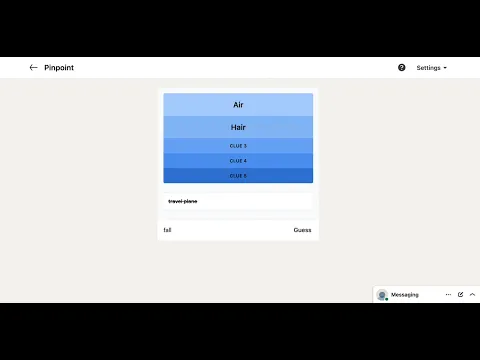
LinkedIn Pinpoint #559 Answer & Analysis
Looking for the Pinpoint #559 answer? Beyond Air, Hair, Makeup, Paint, and Tooth, the logic is trickier than you think. It's not about things you apply! Get our fast answer and expert logic tips below to save your streak now.
LinkedIn Pinpoint 559 Clues & Answer
💡 Hover (desktop) or tap (mobile) each clue to see how it connects to the answer
#1
Forms "Airbrush," a tool used for spraying paint using compressed air.
#2
Forms "Hairbrush," perhaps the most universally recognized use of the word.
#3
Forms "Makeup brush," used for the application of powders and creams.
#4
Forms "Paintbrush," spanning the gap between fine art and industrial coating.
#5
Forms "Toothbrush." The "if not on stands" refers to electric charging bases or bathroom holders.
Answer: Words that come before 'brush'
LinkedIn Pinpoint #559 Expert Logic
1. Introduction
LinkedIn Pinpoint #559 is a masterclass in linguistic versatility. While the clues span the realms of personal hygiene, fine art, and industrial technology, they are all tethered to a single, ubiquitous tool. This puzzle challenges players to identify a "missing link" that transforms five disparate nouns into specific, functional instruments used in daily life and specialized trades.
2. How the Puzzle Came Together
The logic of this puzzle is built on the daily transition from personal grooming to professional output. It likely began with the most common household items: the Hair brush and the Makeup brush, which establish a theme of "personal care." However, the puzzle designers elevated the difficulty by introducing Paint, which pivots the logic toward the arts and home improvement.
To ensure the category wasn't too broad (like "items in a bathroom"), the inclusion of Air acts as a technical bridge, pointing toward the "Airbrush" used in graphic design and automotive work. The final "logical anchor," Tooth (if not on stands), provides a specific physical hint. By mentioning "stands," the puzzle references the common way we store a toothbrush, effectively locking the player into the "brush" suffix. This progression from soft grooming to hard utility is a classic Pinpoint construction.
3. Category: Pinpoint 559
- A. Core Answer: Words that come before 'brush'
- B. Difficulty Rating: 1.8 / 5.0 (The items are very common, making the connection relatively intuitive for most players).
4. Words & How They Fit
Semantic Logic Breakdown
- Suffix Synthesis: Each clue requires the addition of the word "brush" to create a standard compound noun or noun phrase.
- Functional Diversity: The resulting tools range from manual hygiene instruments to pneumatic artistic devices.
Logic Role Classification
| Clue | Logical Role | Why it fits |
|---|---|---|
| Air | The Technical Pivot | Forms "Airbrush," a tool used for spraying paint using compressed air. |
| Hair | The Grooming Anchor | Forms "Hairbrush," perhaps the most universally recognized use of the word. |
| Makeup | The Cosmetic Link | Forms "Makeup brush," used for the application of powders and creams. |
| Paint | The Artistic Anchor | Forms "Paintbrush," spanning the gap between fine art and industrial coating. |
| Tooth | The Qualifier (Key) | Forms "Toothbrush." The "if not on stands" refers to electric charging bases or bathroom holders. |
5. Better Analysis Directions
A. Semantic Trap Analysis (The "Morning Routine" Trap)
A common pitfall in #559 is narrowing the logic too quickly to "Things in a Bathroom." While Hair, Makeup, and Tooth fit this perfectly, Paint and Air do not. The "Expert" player recognizes that when a subset of clues fits a location but the others don't, the connection must be linguistic (a shared word) rather than situational (a shared place).
B. Historical Pattern (The Suffix Strategy)
Pinpoint frequently utilizes the "Common Suffix" pattern. In the history of the game, when clues represent very different industries (like dentistry vs. automotive painting), the logic is almost always a "Blank Filler." The "if not on stands" qualifier is a hallmark of Pinpoint's style—providing a physical hint to prevent the puzzle from being purely abstract.
C. The Expert Workflow
- Identify the Pair: Hair and Makeup immediately suggest "brush."
- Test the Theory: Does "brush" work with Paint? Yes. Does it work with Air? Yes (Airbrush).
- Verify the Anchor: Does "Toothbrush" make sense with the "stands" hint? Yes, especially in the age of electric toothbrushes.
- Finalize: Confirm that "brush" is the only word that fits all five without exception.
6. Lessons Learned From Pinpoint 559
This puzzle teaches us to look for functional suffixes. When you see a list of nouns that seem to belong to different rooms of a house, try "attaching" a common tool word to them. Pinpoint #559 rewards players who can think across different "domains" (Beauty, Art, Hygiene) to find the linguistic thread that binds them.
💡 Trivia: The Billion-Dollar Bristle History
The Toothbrush mentioned in this puzzle has a surprisingly royal (and macabre) history. While humans used "chew sticks" for millennia, the first mass-produced toothbrush was designed by William Addis in 1780—while he was in prison!
He saved a small animal bone from a meal, bored holes in it, and tied in tufts of cow tail hair provided by a guard. After his release, he started a company that made him incredibly wealthy. It wasn't until 1938 that DuPont replaced animal hair with the Nylon bristles we recognize today, forever changing the "brush" industry!
FAQ
Q: Why was the "if not on stands" qualifier added to "Tooth"? A: To distinguish the toothbrush from other "tooth" related items and to provide a physical context. Most people store toothbrushes in a cup or on a stand; by mentioning the stand, the puzzle nudges you toward the physical object.
Q: Is "Airbrush" one word or two? A: It is typically written as one word (compound noun), whereas "Makeup brush" or "Paint brush" are often two words. Pinpoint logic allows for both compound words and common phrases.
Watch the logic walkthrough