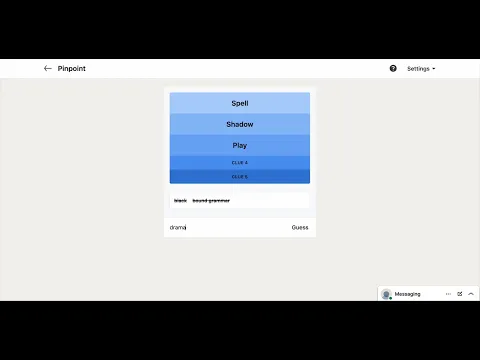
LinkedIn Pinpoint #583 Answer & Analysis
Looking for the Pinpoint #583 answer? Beyond Spell, Shadow, Play, Fishing line, and Vote, the logic is trickier than you think. It's not about things that are actions! Get our fast answer and expert logic tips below to save your streak now.
LinkedIn Pinpoint 583 Clues & Answer
💡 Hover (desktop) or tap (mobile) each clue to see how it connects to the answer
#1
To "cast a spell" is the act of performing magic or an incantation.
#2
An object blocks light to "cast a shadow" on a surface.
#3
The director's job to "cast a play" involves assigning roles to actors.
#4
To "cast a line" is the mechanical act of throwing a lure into the water.
#5
To "cast a vote" is the formal act of registering a choice in an election.
Answer: Things you cast
LinkedIn Pinpoint #583 Expert Logic
1. Introduction
Welcome to the expert breakdown of LinkedIn Pinpoint #583. This puzzle is a masterclass in "Verb-Object Collocation." It challenges players to identify a "Linguistic Chameleon"—a single verb that changes its meaning entirely depending on the noun it is paired with. Whether you are in a theater, on a boat, or in a voting booth, the action remains the same.
2. How the Puzzle Came Together
The logic of #583 relies on the breadth of the word "Cast." The puzzle starts with Spell and Shadow, which are common metaphorical and physical uses of the term. While "casting a spell" feels mystical, "casting a shadow" is a simple matter of optics.
The difficulty increases with Play and Fishing line. In a theatrical context, "casting a play" refers to the selection of actors, whereas "casting a fishing line" is a physical throwing motion. Finally, Vote serves as the civic anchor. While we don't physically "throw" our votes anymore, the idiom "to cast a vote" remains the standard terminology in modern democracy.
[Image showing different meanings of the verb cast: fishing, theater, and voting]
3. Category: Pinpoint 583
- A. Core Answer: Things you cast
- B. Difficulty Rating: 2.4 / 5.0 (Moderate. Most players will find the connection through "Spell" or "Vote" quickly.)
4. Words & How They Fit
Semantic Logic Breakdown
The connection is the verb "To Cast." This verb is unique because it functions as a synonym for "to throw," "to select," "to emit," and "to record" all at once.
Logic Role Classification
| Clue (Word) | Logical Role | Why it fits |
|---|---|---|
| Spell | Mythical Action | To "cast a spell" is the act of performing magic or an incantation. |
| Shadow | Optical Phenomenon | An object blocks light to "cast a shadow" on a surface. |
| Play | Professional Task | The director's job to "cast a play" involves assigning roles to actors. |
| Fishing line | Physical Motion | To "cast a line" is the mechanical act of throwing a lure into the water. |
| Vote | Civic Duty | To "cast a vote" is the formal act of registering a choice in an election. |
5. Better Analysis Directions
A. Red Herring Analysis (The "Performance" Trap)
A player might see Play and Spell and think the category is "Theater" or "Performance." However, Fishing line and Vote have no place in a theater. The "Expert" realizes that the link isn't the setting, but the specific action applied to the objects.
B. Historical Pattern (Action-Noun Pairs)
Pinpoint frequently uses the "Common Verb" logic. When you see a list of nouns that seem unrelated, the standard expert workflow is to try a high-frequency verb (like Run, Set, Cast, or Take) against each one to see if a pattern emerges.
C. The Expert Workflow
- Spot the idiom: Cast a vote is a very strong, specific phrase.
- Test the verb: Does "Cast" work with Shadow? Yes. With Spell? Yes.
- Cross-check the outliers: Does a director "cast" a Play? Yes.
- Confirm the Answer: Generalize to "Things you cast."
6. Lessons Learned From Pinpoint 583
This puzzle teaches us that English is a language of idioms. Many of our most common phrases (like "casting a vote") are relics of physical actions from the past that have become abstract over time.
💡 Trivia: The Ancient "Cast" of a Vote
The phrase "to cast a vote" is far more literal than you might think. In Ancient Greece, citizens would often vote using small stones (called psephos) or seashells. To record their choice, they would physically cast (throw) their stone into one of two urns. This physical act of "casting" a pebble is where we get the term "psephology"—the statistical study of elections and voting!
FAQ
Q: Can "Cast" also apply to metal? A: Yes! You can also "cast" metal or plaster in a mold. While not included in this puzzle, it fits the same linguistic logic of "shaping or throwing" a material.
Q: Why is "Play" included instead of "Movie"? A: You can cast both, but "casting a play" is a more traditional theatrical term that balances well with "Spell" and "Shadow" for a balanced puzzle.
Watch the logic walkthrough