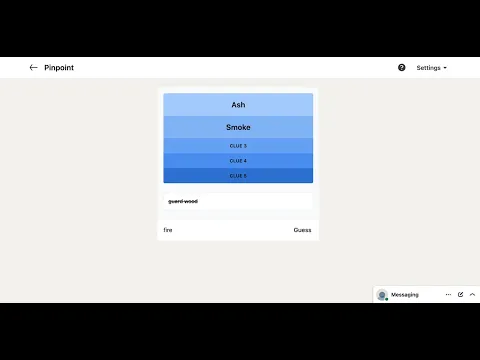
LinkedIn Pinpoint #591 Answer & Analysis
Looking for the Pinpoint #591 answer? Beyond Ash, Smoke, Battleship, Slate, and Silver, the logic is trickier than you think. It's not about types of industrial materials! Get our fast answer and expert logic tips below to save your streak now.
LinkedIn Pinpoint 591 Clues & Answer
💡 Hover (desktop) or tap (mobile) each clue to see how it connects to the answer
#1
A light, pale gray resembling burnt wood or volcanic residue.
#2
A soft, translucent, or hazy gray.
#3
A medium-to-dark matte gray used as camouflage for naval vessels.
#4
A dark gray with subtle blue or purple undertones, like the metamorphic rock.
#5
A bright, reflective gray that mimics the appearance of the precious metal.
Answer: Shades of gray
LinkedIn Pinpoint #591 Expert Logic
1. Introduction
Welcome to the expert breakdown of LinkedIn Pinpoint #591. Today's puzzle is a masterclass in Color Theory and Descriptive Adjectives. It asks players to look past the physical nature of the clues—whether they are gases, solids, or massive machines—and focus instead on their specific visual signature.
2. How the Puzzle Came Together
The logic of this puzzle is built on "Progressive Neutrality." The journey begins with Ash and Smoke, which immediately suggest a theme of "Fire" or "Burning." However, the introduction of Battleship—a term famously synonymous with a specific military-grade hue—forces the player to pivot from "combustion" to "color."
The set is rounded out by Slate, representing the blue-gray of geological stone, and Silver, which adds a metallic, lustrous finish to the group. By connecting the natural world (Ash, Slate) with the industrial world (Battleship, Silver), the puzzle identifies a singular, shared aesthetic: the Shade of Gray.
3. Category: Pinpoint 591
- A. Core Answer: Shades of gray
- B. Difficulty Rating: 1.2 / 5.0 (Easy. The clues are very consistent and the "color" category is a frequent Pinpoint staple.)
4. Words & How They Fit
Semantic Logic Breakdown
The connection is Visual Taxonomy. Each word serves as a descriptive adjective for a specific variation of the color gray, ranging from light and warm to dark and cool.
Logic Role Classification
| Clue (Word) | Logical Role | Why it fits |
|---|---|---|
| Ash | Biological/Warm | A light, pale gray resembling burnt wood or volcanic residue. |
| Smoke | Atmospheric | A soft, translucent, or hazy gray. |
| Battleship | Industrial/Military | A medium-to-dark matte gray used as camouflage for naval vessels. |
| Slate | Geological/Cool | A dark gray with subtle blue or purple undertones, like the metamorphic rock. |
| Silver | Metallic/Shiny | A bright, reflective gray that mimics the appearance of the precious metal. |
5. Better Analysis Directions
A. Red Herring Analysis (The "Combustion" Trap)
The pair of Ash and Smoke is a classic "opening trap." A player might spend the first few seconds looking for words like "Fire," "Flame," or "Cigarette." However, the sheer scale of a Battleship makes it impossible to fit into a fire-based theme, acting as a "reset button" for the player's logic.
B. Historical Pattern (The Descriptive Set)
LinkedIn Pinpoint frequently uses "Adjective Categories"—sets where nouns are used to describe a specific property (like colors or textures). In historical datasets, color-based puzzles are among the most common "Introductory" puzzles because they rely on universal visual associations.
C. The Expert Workflow
- Identify the pivot: See Ash and Smoke, acknowledge "Fire," but immediately check if the third word (Battleship) fits.
- Translate to color: Once "Fire" fails, ask: "What color is a Battleship?" (Gray).
- Cross-verify: Does "Gray" work for Slate? Yes. Does it work for Silver? Yes.
- Confirm the Answer: Finalize as "Shades of gray."
6. Lessons Learned From Pinpoint 591
This puzzle reminds us that Specific Nouns are often just Adjectives in disguise. When you see a word like "Battleship," don't just think about the ship; think about its most iconic attribute—its color.
💡 Trivia: The Camouflage of "Battleship Gray"
The term "Battleship Gray" isn't just an aesthetic choice; it’s a product of wartime science! During the early 20th century, the British and American navies experimented with different shades to help ships disappear against the horizon. They discovered that a specific neutral gray was the most effective at blending in with the "sea-and-sky" background of the North Atlantic. In fact, during WWI, they even used a more radical version called "Dazzle Camouflage," which used bold, jagged gray and black patterns to confuse enemy submarines about a ship's speed and direction!
FAQ
Q: Is "Grey" or "Gray" the correct spelling? A: Both! "Gray" is the standard American English spelling, while "Grey" is the standard British English spelling. LinkedIn Pinpoint typically uses the American "a" version.
Q: Can "Slate" be other colors? A: While slate rock can occasionally have green or red tints, in the context of color theory, "Slate" almost exclusively refers to a dark, blueish gray.
Watch the logic walkthrough