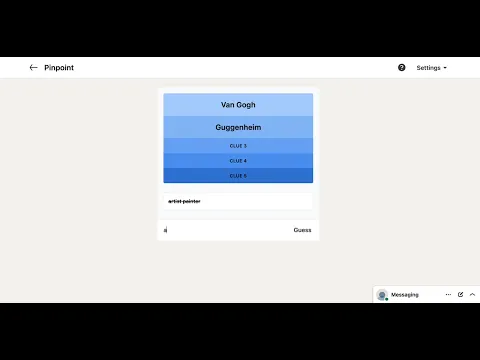
LinkedIn Pinpoint #595 Answer & Analysis
Looking for the Pinpoint #595 answer? Beyond Van Gogh, Guggenheim, Prado, Salar Jung, and Louvre, the logic is trickier than you think. It's not about specific artists! Get our fast answer and expert logic tips below to save your streak now.
LinkedIn Pinpoint 595 Clues & Answer
💡 Hover (desktop) or tap (mobile) each clue to see how it connects to the answer
#1
Located in Amsterdam, Netherlands; holds the world's largest collection of Van Gogh's works.
#2
Represents a series of art museums operated by the Solomon R. Guggenheim Foundation.
#3
Spain's premier art museum, housing masterpieces by Velázquez and Goya.
#4
One of the three National Museums of India, proving the global universality of the category.
#5
The French Louvre is not only the world's largest museum but also the logical starting point for the set.
Answer: Museums
LinkedIn Pinpoint #595 Expert Logic
1. Introduction
Welcome to the deep-dive analysis of LinkedIn Pinpoint #595. This edition is a grand narrative of the temples of human civilization. Spanning Europe, Asia, and North America, these clues represent everything from Renaissance treasures to the pinnacles of modern architecture. These words are more than just names; in a global context, they are synonymous with "encyclopedic collections."
2. How the Puzzle Came Together
The logic of this puzzle utilizes a strategy of "Global Coverage" and "Type Diversity." The curators lead with the Louvre, the "gold standard" of global museums, establishing a majestic cultural tone. This is followed by the Prado, shifting the focus to the Spanish royal collections.
To add complexity, the Van Gogh Museum is introduced. While "Van Gogh" is an artist's name, in this context, it represents the specific institution in Amsterdam dedicated to his work. The Guggenheim adds a touch of modernity, with its unique architectural forms and franchise-like operations solidifying the logic. Finally, the Salar Jung Museum is the masterstroke; by including this premier collection in Hyderabad, India, the puzzle breaks away from Eurocentrism, forcing players to aggregate concepts under the higher-dimensional umbrella of "Global Museums."
3. Category: Pinpoint 595
- A. Core Answer: Museums
- B. Difficulty Rating: 1.8 / 5.0 (Easy. Due to the high visibility of the Louvre and Guggenheim, players can quickly lock onto the core concept.)
4. Words & How They Fit
Semantic Breakdown
- Spatial Commonality: All clues point to permanent institutions dedicated to preserving, researching, and exhibiting tangible evidence of human culture, art, or science.
- Naming Logic: These names cover various naming conventions, including geographic, patron-based, and artist-memorial names.
| Clue | Logical Role | Why it fits |
|---|---|---|
| Van Gogh | Artist Memorial Landmark | Located in Amsterdam, Netherlands; holds the world's largest collection of Van Gogh's works. |
| Guggenheim | Foundation/Modern Landmark | Represents a series of art museums operated by the Solomon R. Guggenheim Foundation. |
| Prado | National Cultural Anchor | Spain's premier art museum, housing masterpieces by Velázquez and Goya. |
| Salar Jung | Geographic Diversity Anchor | One of the three National Museums of India, proving the global universality of the category. |
| Louvre | Category Definer | The French Louvre is not only the world's largest museum but also the logical starting point for the set. |
5. Better Analysis Directions
A. Red Herring Analysis
The primary trap is the "Personal Names" category. If a player sees Van Gogh and Guggenheim first, they might guess "Famous Art Patrons" or "Artists." However, the Prado (a building name derived from a location) and the Louvre (a former palace name) quickly correct this bias, pulling the logic back to the "Institutional Venue."
B. Historical Pattern
In Pinpoint's historical data, "Sets of Premier Proper Nouns" are a common pattern. These puzzles typically select the "Crown Jewels" of each subfield. For example, a "Museum" set will almost inevitably include the Louvre. Identifying the commonality of "Premier Institutions" is key.
C. Expert Workflow
- Identify Landmark Terms: Seeing Louvre immediately triggers "Museum" or "Paris."
- Multi-point Trigger: Seeing Prado confirms the "Museum" logic (as it is not just a city name).
- Eliminate Ambiguity: Seeing Van Gogh eliminates "Artist" as the category (as it cannot form a parallel logic with Prado or Louvre).
- Conclusion: Finalize all items as world-famous Museums.
6. Lessons Learned
This puzzle teaches us that the "Social Attributes" of proper nouns often outweigh their "Literal Meanings." When solving such puzzles, don't be misled by the original attributes of a word (like a surname); instead, consider its function as a public space or brand symbol in contemporary society.
💡 Trivia: The "Veiled" Beauty and "Double" Mystery
While the Louvre houses the Mona Lisa, the Salar Jung Museum houses a marvel of sculpture known as the Veiled Rebecca. Carved from a single block of white marble, the artist Giovanni Maria Benzoni managed to make the stone look like a transparent gossamer veil—a feat of "expertise" that challenges the limits of material.
Additionally, the museum's Double Statue (Mephistopheles and Margaretta) is carved from a single block of wood. When viewed from the front, it is the male figure Mephistopheles; when viewed in a mirror from the back, it is the female figure Margaretta. It remains one of the most photographed and logically intriguing museum exhibits in the world.
FAQ
Q: Is there a difference between a "Museum" and an "Art Gallery" in this context? A: While they often overlap, "Museum" is a broader term. Institutions like the Louvre and Salar Jung contain historical artifacts and decorative arts beyond just paintings, which is why "Museums" is the more accurate collective noun.
Q: Why was the Salar Jung included specifically? A: It adds a layer of "Experience" for players familiar with global culture. It elevates the puzzle from a Western-centric list to a truly international one, rewarding players who possess broad geographical knowledge.
Watch the logic walkthrough