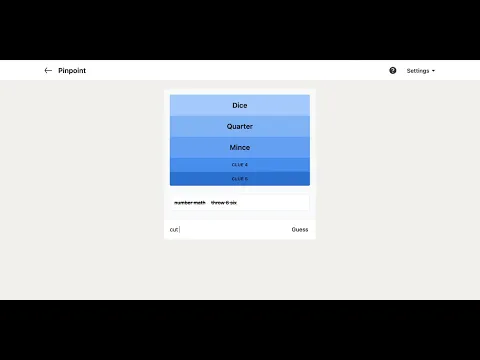
LinkedIn Pinpoint #636 Answer & Analysis
Looking for the Pinpoint #636 answer? Beyond Dice, Quarter, Mince, Chop, and Slice, the logic is trickier than you think. It's not about things you gamble with! Get our fast answer and expert logic tips below to save your streak now.
LinkedIn Pinpoint 636 Clues & Answer
💡 Hover (desktop) or tap (mobile) each clue to see how it connects to the answer
#1
While it means "to cut into cubes," it initially lures the player toward "Games."
#2
To cut into four equal parts; it tests if the player can move past the "Currency" definition.
#3
A very specific culinary term that is rarely used outside of food preparation.
#4
The most basic form of cutting; it establishes the "cutting" theme immediately.
#5
Refers to long, thin pieces; completes the set of standard kitchen knife techniques.
Answer: Ways to cut food with a knife to prepare for cooking
LinkedIn Pinpoint #636 Expert Logic
1. Introduction
LinkedIn Pinpoint #636 is a masterclass in linguistic precision within a specialized field. While several of the words in this set have common meanings in finance or gaming, their collective presence points toward a singular destination: the kitchen. This puzzle tests the player's ability to pivot from "noun-heavy" thinking to "action-oriented" culinary techniques.
2. How the Puzzle Came Together
The logic of this puzzle is built on the progression of knife skills. It starts with Chop and Slice, the two most common verbs any home cook encounters. These provide the "thematic foundation." However, the puzzle gains complexity with Dice and Quarter. In any other context, a "dice" is a gaming tool and a "quarter" is a coin, but when placed alongside Mince, the financial and recreational definitions evaporate.
The final clue, Slice, acts as the definitive link. By grouping these specific actions, the puzzle creates a logical "Culinary Workflow." Each word describes a specific physical transformation of an ingredient, moving from the rough Chop to the delicate, high-surface-area Mince.
3. Category: Pinpoint 636
- A. Core Answer: Ways to cut food with a knife to prepare for cooking
- B. Difficulty Rating: 1.8 / 5.0 (The words are common, though the dual meanings of "Dice" and "Quarter" provide a slight initial hurdle).
4. Words & How They Fit
Semantic Logic Breakdown
- Geometric Transformation: Each clue represents a different geometric outcome (cubes, slivers, quarters, or fine grains).
- Culinary Intent: Each method is chosen based on the required cooking time or texture of the final dish.
Logic Role Classification
| Clue | Logical Role | Why it fits |
|---|---|---|
| Chop | The Generalist | The most basic form of cutting; it establishes the "cutting" theme immediately. |
| Dice | The Geometric Distractor | While it means "to cut into cubes," it initially lures the player toward "Games." |
| Quarter | The Numerical Distractor | To cut into four equal parts; it tests if the player can move past the "Currency" definition. |
| Mince | The Specialty Anchor | A very specific culinary term that is rarely used outside of food preparation. |
| Slice | The Texture Variable | Refers to long, thin pieces; completes the set of standard kitchen knife techniques. |
5. Better Analysis Directions
A. Red Herring Analysis (The "Common Noun" Trap)
The primary challenge in #636 is the "Homonym Trap." If a player sees Dice and Quarter first, their brain may jump to "Things found in a casino" or "Items in a pocket." The "Expert" solver waits for the third clue—Mince—which acts as a linguistic filter, instantly disqualifying the "Money" or "Games" categories and locking in the "Culinary" theme.
B. Historical Pattern (Functional Verbs)
Pinpoint often uses categories that describe Specific Actions (e.g., Ways to move in Chess, Ways to cook an egg). #636 fits this pattern by focusing on the "How" rather than the "What." The game rewards players who can identify a "Verb Bridge" where all clues share a common purpose.
C. The Expert Workflow
- De-contextualize: Look at Dice and Quarter and recognize they are polysemous (have multiple meanings).
- Thematic Locking: Use Mince and Chop to define the domain (Kitchen/Cooking).
- Cross-Check: Does Slice fit the kitchen theme? Yes. Does Quarter work as a verb in the kitchen? Yes (e.g., quartering an apple).
- Final Synthesis: Define the relationship—they aren't just "kitchen words," they are specific "knife techniques."
6. Lessons Learned From Pinpoint 636
This puzzle teaches us to prioritize verbs over nouns when multiple definitions are available. In the world of Pinpoint, if a word can be an action, it often is the action that connects the set. Always look for the "Specialty Word" (like Mince) to act as your North Star when other clues are too broad.
💡 Trivia: The "Smallest" Cut in the Kitchen
While the puzzle features Dice and Mince, there is a professional French cut even smaller than a standard dice called the "Brunoise." To achieve a Brunoise, the chef first cuts the food into "Julienne" (matchsticks) and then turns them to cut them into tiny cubes, usually only 2mm x 2mm x 2mm.
This isn't just for show! The reason we Mince or Dice so finely is to increase the surface area of the food. This allows more flavor compounds (like the oils in garlic or onions) to be released into the dish and ensures the ingredient "dissolves" into the sauce for a consistent texture.
FAQ
Q: Can "Dice" and "Quarter" be nouns in this puzzle? A: While they are commonly nouns, in the context of this specific Pinpoint set, they function as imperative verbs (commands) describing a preparation method.
Q: Is there a difference between "Chop" and "Mince"? A: Yes. "Chop" usually results in bite-sized, irregular pieces where precision isn't vital. "Mince" is the finest possible cut, often used for aromatics so they distribute evenly throughout a dish.
Watch the logic walkthrough