LinkedIn Pinpoint #643 Answer & Analysis
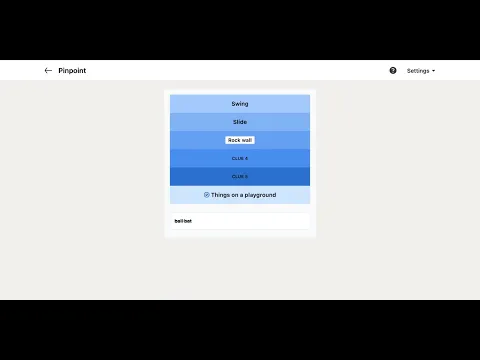
Looking for the Pinpoint #643 answer? Beyond Swing, Slide, Rock wall, Monkey bars, and Seesaw, the logic is trickier than you think. It's not about action verbs! Get our fast answer and expert logic tips below to save your streak now.
LinkedIn Pinpoint 643 Clues & Answer
💡 Hover (desktop) or tap (mobile) each clue to see how it connects to the answer
#1
The most universal symbol of playground equipment.
#2
Complements the swing; focuses on descent and gravity.
#3
Represents the "climbing" aspect of contemporary play structures.
#4
Focuses on upper-body strength and suspension.
#5
The specific caveat "if not on stands" acts as the final filter to confirm the location.
Answer: Things on a playground
LinkedIn Pinpoint #643 Expert Logic
1. Introduction
LinkedIn Pinpoint #643 invites players to revisit the landscapes of childhood. This particular puzzle is a classic example of environmental grouping, where disparate physical structures are unified by their specific setting. While each clue represents a different type of physical movement—swinging, sliding, climbing, or balancing—they all converge within the architectural boundaries of a public or school recreational area.
2. How the Puzzle Came Together
The puzzle construction utilizes a high degree of thematic consistency. It starts with the Swing and the Slide, the "big two" of any recreational space. These clues establish a strong mental image of kinetic play. To prevent the category from being too broad (such as "Physical Exercise"), the puzzle introduces the Rock wall and Monkey bars. These clues shift the focus from simple motion to specific equipment found in modern play structures.
The logical "anchor" arrives with the Seesaw (if not on stands). Much like previous Pinpoint puzzles that use parenthetical qualifiers, this note is crucial. By specifying "if not on stands," the puzzle distinguishes the playground version—which is anchored into the ground or a specific base—from portable or tabletop versions. This refinement locks the logic into a fixed, outdoor location.
3. Category: Pinpoint 643
- A. Core Answer: Things on a playground
- B. Difficulty Rating: 1.8 / 5.0 (The clues are highly iconic and the parenthetical hint provides a clear path to the solution).
4. Words & How They Fit
Semantic Logic Breakdown
- Kinetic Diversity: The set covers various physical forces: Pendulum motion (Swing), Gravity/Friction (Slide), Vertical Tension (Rock wall), and Equilibrium (Seesaw).
- Stationary Infrastructure: Unlike "toys" (which are portable), these are "fixtures" that are typically bolted or cemented into a specific environment.
Logic Role Classification
| Clue | Logical Role | Why it fits |
|---|---|---|
| Swing | The Classic | The most universal symbol of playground equipment. |
| Slide | The Kinetic Link | Complements the swing; focuses on descent and gravity. |
| Rock wall | Modern Addition | Represents the "climbing" aspect of contemporary play structures. |
| Monkey bars | The Physical Challenge | Focuses on upper-body strength and suspension. |
| Seesaw | The Definitive Hint | The specific caveat "if not on stands" acts as the final filter to confirm the location. |
5. Better Analysis Directions
A. Red Herring Analysis (The "Gym" Trap)
A novice player might initially lean toward "Gym Equipment" upon seeing Rock wall and Monkey bars. However, the presence of a Slide and Swing quickly invalidates this. In Pinpoint, the correct answer must accommodate the "lowest common denominator" of all clues. A slide is rarely found in a professional gym, but all five are staples of a playground.
B. Historical Pattern (Location-Based Logic)
Pinpoint frequently utilizes Mode-5 (Location-Based) logic. Historically, when the game presents a list of nouns that are physical objects, the answer is almost always the "container" or "environment" where they coexist. Previous examples include "Things in a toolbox" or "Things in a kitchen."
C. The Expert Workflow
- Pattern Recognition: Group Swing and Slide immediately as "Playground" or "Park."
- Stress Testing: Check if Rock wall and Monkey bars fit that environment. (They do).
- Qualifier Assessment: Analyze the "Seesaw (if not on stands)" hint. This is a classic Pinpoint tactic to eliminate ambiguity.
- Final Synthesis: Define the location precisely: "A playground."
6. Lessons Learned From Pinpoint 643
This puzzle teaches us the value of Environmental Anchoring. When clues describe physical objects, the most successful strategy is to visualize a single 3D space where all those objects could exist simultaneously. Furthermore, #643 reinforces that Pinpoint is often a test of "General Knowledge" rather than "Niche Expertise," making the most obvious connection usually the correct one.
💡 Trivia: The Surprising Science of the Pendulum
💡 Trivia: The Physics of the "Perfect" Swing
Did you know that a Swing is actually a giant pendulum? The "pumping" motion a child does to go higher is a real-world application of Parametric Resonance. By changing their center of gravity at specific points in the arc, the swinger adds energy to the system.
Interestingly, the "Seesaw" mentioned in this puzzle relies on the Law of the Lever, first described by Archimedes. In a playground setting, if one child is twice as heavy as the other, they must sit half as far from the center (the fulcrum) to maintain balance. It’s a live physics lesson hidden in plain sight!
FAQ
Q: Why was the "if not on stands" qualifier used for the Seesaw? A: This prevents confusion with "Teeter-totters" used in physical therapy or small plastic toys used in nurseries. It specifies the heavy, fixed equipment found in public parks.
Q: Is a Rock wall common on playgrounds? A: Yes. In the last 20 years, "Natural Play" and "Climbing Challenges" have replaced many traditional metal structures to improve children's motor skills and grip strength.
Watch the logic walkthrough