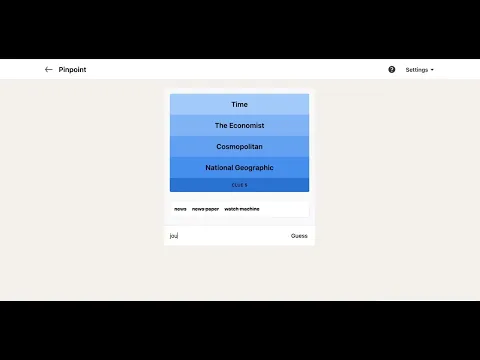
LinkedIn Pinpoint #685 Answer & Analysis
Quick Summary: Stuck on Pinpoint #685? Time, The Economist, and Cosmopolitan might seem like a random collection of reading and publication items, but they share a clever Specialty Set. Below, get the fast, accurate answer & 30s expert logic to save your streak!
LinkedIn Pinpoint 685 Clues & Answer
💡 Hover (desktop) or tap (mobile) each clue to see how it connects to the answer
#1
Acts as a brilliant red herring, making you think of the abstract concept of hours/minutes rather than the proper noun of the publication.
#2
Nudges you toward business, news, or professions, breaking the "clock" theory but keeping you guessing.
#3
Has dual meanings (cocktail/worldview), but alongside the first two, it firmly cements the media/periodical theme.
#4
An unambiguous proper noun that instantly evokes imagery of iconic magazine covers and yellow borders.
#5
A classic, globally recognized publication that perfectly caps off the category.
Answer: Magazines (with global readership / versions)!
LinkedIn Pinpoint #685 Expert Logic
🧠 Expert Logic Walkthrough
When you first see Time, what's the immediate reaction? Naturally, your brain goes straight to the abstract concept. I immediately thought of clocks, hours, minutes, or maybe even phrases like "time of day." It's such a foundational, everyday word that it rarely behaves as a proper noun in your initial thought process.
Then they hit you with The Economist. Wait, if I look at it this way, the "time and money" connection pops up. I spent a good few seconds wondering if this was a puzzle about phrases—maybe something like "Time is money" linking to economists? But that felt a little too loose for a Pinpoint puzzle.
That’s where it clicked, thanks to Cosmopolitan. Suddenly, the "time and money" theory evaporated. A cosmopolitan is a famous cocktail, sure, but how does that link to an economist and time? Oh, right! Time isn't just a ticking clock; it's a massive weekly publication. The Economist isn't a person; it's a newspaper format periodical. And Cosmopolitan isn't a drink here; it's the iconic fashion and lifestyle glossy. We're looking at famous global print media!
To confirm, I rolled out the rest. National Geographic immediately brings to mind that iconic yellow border and stunning photography, while Reader’s Digest gives that nostalgic feeling of sitting in a doctor's waiting room in the late 90s. The satisfaction of seeing the pattern fit perfectly across all clues to reveal the final answer is exactly why I love this game.
Experience & Summary: The trick here was getting past the lowercase, generic definitions of the early clues. Pinpoint loves to use words that double as common nouns (like time) to hide a set of proper nouns in plain sight. Once you lock onto the capitalization and context, the category practically solves itself.
🎯 Category: Pinpoint 685
Magazines (with global readership / versions)!
🔍 Semantic Analysis: Time, The Economist & More
| Clue | Logical Role | Why it fits |
|---|---|---|
| Time | The Ambiguous Starter | Acts as a brilliant red herring, making you think of the abstract concept of hours/minutes rather than the proper noun of the publication. |
| The Economist | The Pivot | Nudges you toward business, news, or professions, breaking the "clock" theory but keeping you guessing. |
| Cosmopolitan | The "Aha!" Moment | Has dual meanings (cocktail/worldview), but alongside the first two, it firmly cements the media/periodical theme. |
| National Geographic | The Visual Validator | An unambiguous proper noun that instantly evokes imagery of iconic magazine covers and yellow borders. |
| Reader’s Digest | The Nostalgic Closer | A classic, globally recognized publication that perfectly caps off the category. |
📊 Difficulty Rating
1.5 / 5.0
This was a relatively breezy episode! Once you get past the initial misdirection of the word "Time" and avoid the cocktail trap with "Cosmopolitan," the category reveals itself quite generously. The final two clues are so hyper-specific to the publishing world that they leave no room for doubt.
📜 Historical Pattern
Of the classic Pinpoint formulas, today's puzzle leverages the Specialty Set pattern. This is when the game provides a list of specific, named entities that all belong to a distinct, real-world grouping (often proper nouns disguised as common words).
Similar Pinpoint Examples:
- Pinpoint #615: Arsenal, Juventus, Raja Casablanca, Real Madrid, Manchester United → Football teams
- Pinpoint #609: Wonderland, Oz, Narnia, Westeros, Middle-earth → Fantasy lands
- Pinpoint #595: Van Gogh, Guggenheim, Prado, Salar Jung, Louvre → Museums
👉 Learn more about “Specialty Set” pattern.
💡 Lessons Learned From Pinpoint 685
- Beware the abstract opener: Words like "Time" are deliberately placed at the front to send you down a conceptual rabbit hole before the proper nouns arrive.
- Look for the physical cluster: When items feel disconnected, think about where they physically live in the real world. In this case, they all sit together on a newsstand or in a waiting room.
- Mind the dual meanings: "Cosmopolitan" can be a drink, an attitude, or a magazine. Finding the overlap between dual-meaning words is the quickest way to the answer.
🌟 Trivia
Did you know that National Geographic published its very first issue in October 1888? However, its world-famous, instantly recognizable yellow border wasn't actually introduced until 1910! That simple design choice became one of the most successful branding tools in the history of magazines.
🔥 Hot News
Despite the massive cultural shift from print to digital media, legacy magazines like Time continue to dominate global conversations, especially around their annual "Person of the Year" announcements. It just goes to show that while the medium might shift to screens and social feeds, the authoritative weight of these historic publications remains incredibly relevant to our daily news consumption.
🎬 30s Logic Breakdown
Rapid Recap: Watch our focused logic video below to see the connection in action. We start with the abstract concept of "Time," bridge it to "The Economist" via the category "Magazines," and then validate it through the diverse worlds of lifestyle, science, and general interest. It's a perfect example of how proper nouns can disguise themselves as everyday vocabulary.
👉 Watch the pinpoint 685 video walkthrough.
❓ FAQ
What is the answer to Pinpoint 685?
The answer is Magazines (with global readership / versions)!
Why is "Time" considered a difficult first clue?
Because "time" is primarily an abstract noun representing hours and minutes, making it hard to immediately recognize as a proper noun for a specific publication.
Did "Cosmopolitan" refer to the cocktail?
No, it served as a red herring. While it is a famous drink, in the context of The Economist and Time, it refers to the popular women's fashion and lifestyle magazine.
What category of puzzle is this?
This falls under the "Specialty Set" pattern, where all clues are specific named entities belonging to a single real-world grouping.
Watch the logic walkthrough