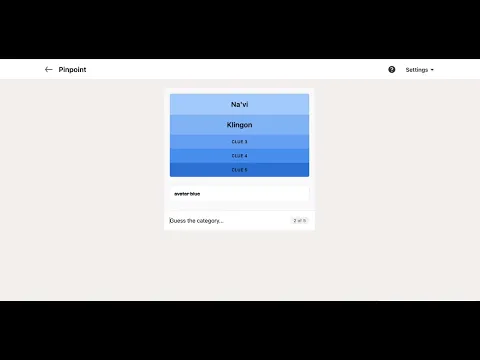
LinkedIn Pinpoint #711 Answer & Analysis
Stuck on LinkedIn Pinpoint 711? What connects Na'vi, Klingon, Elvish, Esperanto, and Interlingua—and why? We've got you covered! This clean brand category is a perfect test of your pattern recognition. Try our interactive hints first, then reveal the 30s expert logic and answer below to save your streak!
LinkedIn Pinpoint 711 Clues & Answer
💡 Hover (desktop) or tap (mobile) each clue to see how it connects to the answer
#1
A highly recognizable fictional language created by Paul Frommer for the *Avatar* film franchise.
#2
A fully functional language developed by Marc Okrand for the *Star Trek* universe.
#3
Encompasses languages like Sindarin and Quenya, meticulously crafted by philologist J.R.R. Tolkien.
#4
Created by L. L. Zamenhof in 1887, serving as the most widely spoken constructed international auxiliary language.
#5
Developed between 1937 and 1951, it uses a naturalistic vocabulary to serve as a bridge language, confirming the "invented" theme.
Answer: Constructed languages!
LinkedIn Pinpoint #711 Expert Logic
🧠 Expert Logic Walkthrough
When you first see Na'vi, what jumps to mind? Giant blue aliens, James Cameron's Avatar, and Pandora. My immediate thought was that we were dealing with blockbuster sci-fi movies or fictional alien races.
Then comes Klingon. Okay, Star Trek. We are definitely in the realm of sci-fi aliens or iconic fictional species. If clue three is "Wookiee" or "Vulcan," we've got a locked-in theme.
But then Elvish throws a slight curve. Tolkien's Lord of the Rings is high fantasy, not sci-fi. So the common denominator broadens from "alien species" to "fictional races." But wait—"Elvish" specifically refers to the language they speak, not the race itself (which would just be "Elves"). Both the Na'vi and Klingons also have incredibly well-documented, fully functional languages created for their respective universes. Could the link be fictional languages?
That theory gets a reality check when Esperanto drops. Esperanto isn't fictional at all; it's a very real international auxiliary language created in the late 19th century to foster global peace. It doesn't belong to a fantasy race. That’s where the real "aha!" moment hits. What do a sci-fi alien dialect, a high-fantasy tongue, and a utopian peace project share? They didn't evolve naturally over millennia. They were purposefully invented by people.
Seeing Interlingua validates this perfectly. It’s another real-world language developed by linguists to be universally understood. The pattern holds flawlessly: these are all languages built from scratch rather than inherited from history.
Experience & Summary: This puzzle is a masterclass in the "pivot." It baits you into a pop-culture rabbit hole (sci-fi/fantasy races) before using a real-world anchor (Esperanto) to snap you back to the structural reality of the clues. The key to lateral thinking here is paying attention to the specific noun forms—"Elvish" instead of "Elves" was the quiet clue that the theme was linguistic, not biological.
🎯 Category: Pinpoint 711
Constructed languages!
🔍 Semantic Analysis: Na'vi, Klingon & More
| Clue | Logical Role | Why it fits |
|---|---|---|
| Na'vi | Pop Culture Anchor | A highly recognizable fictional language created by Paul Frommer for the Avatar film franchise. |
| Klingon | Sci-Fi Classic | A fully functional language developed by Marc Okrand for the Star Trek universe. |
| Elvish | Fantasy Pioneer | Encompasses languages like Sindarin and Quenya, meticulously crafted by philologist J.R.R. Tolkien. |
| Esperanto | Real-World Pivot | Created by L. L. Zamenhof in 1887, serving as the most widely spoken constructed international auxiliary language. |
| Interlingua | Validating Clue | Developed between 1937 and 1951, it uses a naturalistic vocabulary to serve as a bridge language, confirming the "invented" theme. |
📊 Difficulty Rating
2.5 / 5.0
This is a satisfyingly balanced puzzle. The pop-culture heavyweights at the beginning make it highly accessible, but it avoids being overly simple by transitioning from fictional pop-culture dialects to actual linguistic academic projects. The "alien race" red herring is strong initially, but the pivot is intuitive enough for most players to grasp by the fourth clue.
📜 Historical Pattern
3. Specialty Set
This puzzle follows the classic "Specialty Set" pattern, where seemingly disparate nouns are united by a highly specific categorical umbrella. Instead of using wordplay or affixes, the game demands that you identify the distinct taxonomic group these items belong to.
Similar Pinpoint Examples:
- Pinpoint #595: Van Gogh, Guggenheim, Prado, Salar Jung, Louvre → Museums
- Pinpoint #609: Wonderland, Oz, Narnia, Westeros, Middle-earth → Fantasy lands
- Pinpoint #651: Eyjafjallajökull, Mauna Loa, Fuji, Krakatoa, Vesuvius → Names of volcanoes!
👉 Learn more about “Specialty Set” pattern.
💡 Lessons Learned From Pinpoint 711
- Beware the genre trap: It's easy to lock into "sci-fi and fantasy" early on. Always be prepared to broaden your categorizations when a non-fiction clue breaks the streak.
- Pay attention to the exact noun form: The use of "Elvish" instead of "Elves" was the subtle hint that the puzzle was about communication and linguistics, not just characters.
- Look for the creator's hand: Finding the invisible common thread—that all these systems were engineered by individuals rather than evolving naturally—is the hallmark of lateral thinking.
- Don't ignore the real-world anchors: Clues like Esperanto and Interlingua act as the "grounding wire" for the puzzle, turning a fun trivia question into a legitimate categorical definition.
🌟 Trivia
Did you know that Klingon is so thoroughly developed that you can actually read full classic literature in it? The Klingon Language Institute famously translated Shakespeare's Hamlet and Much Ado About Nothing into the language, operating on the joke from Star Trek VI: The Undiscovered Country that you haven't experienced Shakespeare until you've read him in the original Klingon! All of these constructed languages boast dedicated communities of fluent speakers.
🔥 Hot News
With James Cameron's highly anticipated Avatar: Fire and Ash on the horizon, the Na'vi language is once again making headlines as linguists work to expand its vocabulary for the newly introduced "Ash People" tribe. This perfectly highlights the ongoing cultural relevance of constructed languages, showing how fictional linguistics can capture the global imagination just as powerfully as visual effects.
🎬 30s Logic Breakdown
Rapid Recap: Watch our focused logic video below to see the connection in action. We start with the pop-culture sci-fi concept of "Na'vi," bridge it to "Klingon" via the linguistic theme "Constructed languages!," and then validate it through the diverse worlds of high fantasy lore, international diplomacy, and academic linguistic design. It's a perfect example of how pattern recognition reveals the artificial, engineered nature of these communication systems.
👉 Watch the pinpoint 711 video walkthrough.
❓ FAQ
Is Esperanto a fictional language?
No, Esperanto is a real-world constructed language (often called a conlang) created in 1887 to serve as a universal second language to foster international peace and understanding.
Who created the Elvish languages?
The Elvish languages, most notably Quenya and Sindarin, were created by J.R.R. Tolkien, who was a professional philologist and famously created the languages first, and then wrote The Lord of the Rings to give them a world to exist in.
What makes Interlingua different from Esperanto?
While both are international auxiliary languages, Esperanto was designed with highly regular, artificial grammar rules to be easy to learn, whereas Interlingua uses "naturalistic" vocabulary and grammar drawn from romance languages, making it immediately readable to millions who haven't even studied it.
Can you actually learn to speak Klingon fluently?
Yes! Klingon has a complete grammar system and an extensive vocabulary. There is a dedicated Klingon Language Institute, and fans around the world have learned to speak it fluently, complete with its own dictionary and translated literature.
Watch the logic walkthrough